
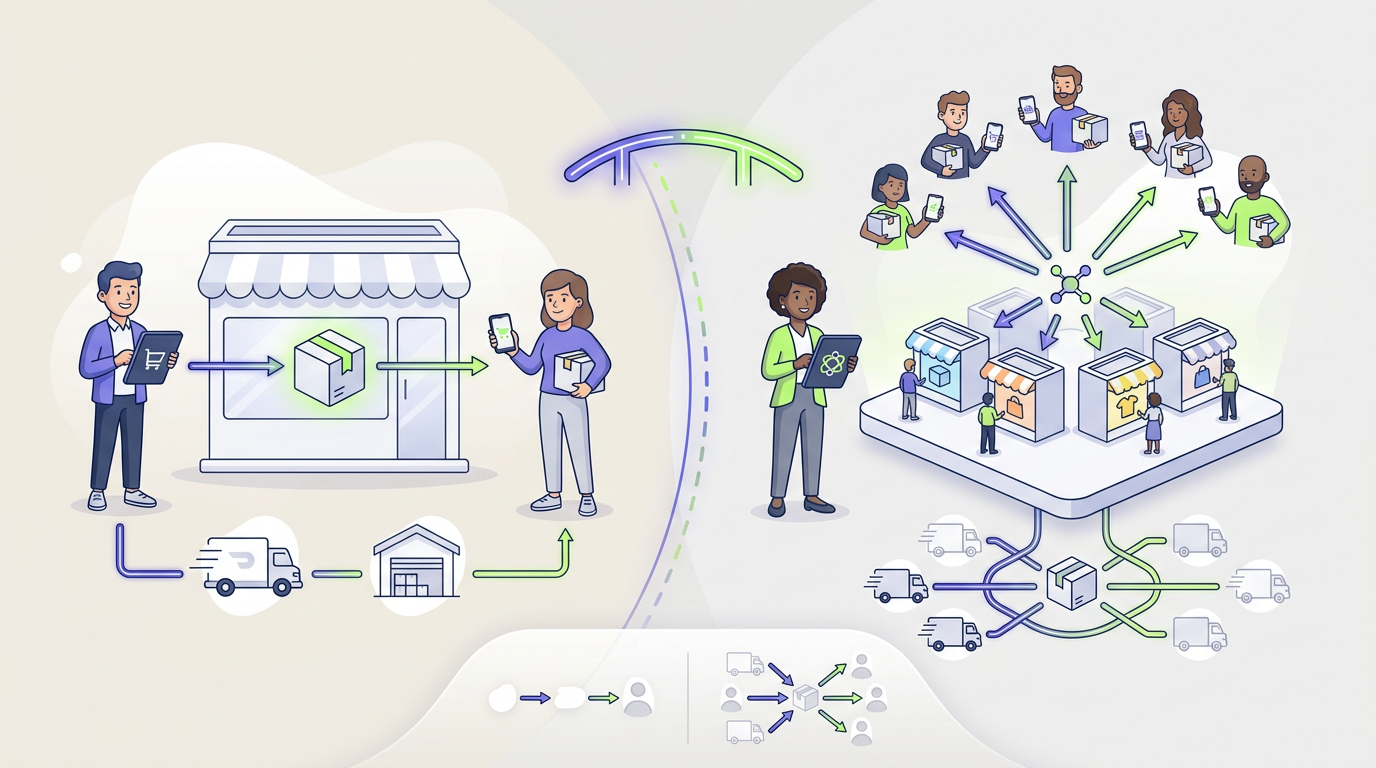
Ecommerce describes any business transaction ordered or negotiated through a digital system, while an online marketplace is a specific ecommerce model that connects multiple independent sellers with buyers. A standalone ecommerce store sells under one business’s control; a marketplace website manages interactions, listings, payments, trust, and rules across many participants.
The practical difference is not simply the number of products displayed on a website. The two models differ in inventory ownership, customer relationships, pricing control, payment flow, revenue structure, operational risk, and the way growth occurs.
An ecommerce business can operate through its own store, a third-party marketplace, social commerce, business-to-business ordering systems, or several channels at once. A marketplace is therefore part of ecommerce, but ecommerce is not limited to marketplaces.
Ecommerce vs Marketplace: The Core Difference
The central difference is the seller relationship.
A conventional online store normally represents one retail business. That business selects the products, controls the website, receives customer orders, sets prices, and takes responsibility for fulfilling the sale.
A marketplace website creates infrastructure through which several independent sellers can offer products or services to a shared audience. The platform may control search, payments, reviews, seller access, dispute procedures, and transaction rules without owning every item listed.
| Criterion | Standalone ecommerce store | Online marketplace |
|---|---|---|
| Primary role | Sells products or services directly | Connects independent sellers with buyers |
| Number of sellers | Usually one retail business | Usually multiple third-party sellers |
| Inventory ownership | Normally owned or controlled by the store | Normally owned by participating sellers |
| Main revenue | Product or service margin | Commissions, fees, subscriptions, advertising, or services |
| Pricing control | Controlled by the retailer | Set by sellers, the platform, or both |
| Customer relationship | Primarily belongs to the retailer | Shared or controlled by platform rules |
| Product range | Limited by one business’s sourcing capacity | Expanded through third-party supply |
| Main growth challenge | Acquire customers and finance inventory | Attract both sellers and buyers |
What Is an Ecommerce Business?
An ecommerce business sells goods or services through digital ordering systems.
The transaction can begin through:
- a standalone online store;
- a mobile application;
- an online marketplace;
- a business ordering portal;
- a social-media storefront;
- an electronic procurement system;
- another digital sales channel.
The defining feature is that the buyer places the order or agrees to the transaction terms through a computer network. Payment and delivery do not always need to occur online.
An ecommerce business can sell:
- physical products;
- digital products;
- subscriptions;
- professional services;
- bookings;
- licenses;
- memberships;
- business supplies;
- access to software or content.
The phrase does not identify one specific operating model. A manufacturer selling through its own website, a retailer listing goods on a marketplace, and a software company selling subscriptions can all participate in ecommerce.
What Is a Marketplace Website?
A marketplace website is a digital platform that allows multiple independent providers to offer goods or services to buyers through a shared interface.
The platform usually supplies some combination of:
- seller registration;
- product listings;
- search and filtering;
- customer accounts;
- shopping-cart functions;
- payment processing;
- reviews and ratings;
- fraud controls;
- order tracking;
- dispute resolution;
- seller reporting;
- advertising tools.
The platform’s main product is not necessarily the merchandise displayed on the website. The platform’s main product may be the infrastructure, audience, transaction process, and trust system used by buyers and sellers.
Our guide to how an online marketplace works explains the participants, marketplace types, transaction process, and platform responsibilities in greater detail.
Is a Marketplace Part of Ecommerce?
Yes. A marketplace is one category within the wider ecommerce ecosystem.
The relationship can be expressed simply:
- Ecommerce describes digitally ordered commercial transactions.
- Online retail describes a seller offering its own inventory directly to customers.
- Online marketplace describes an intermediary facilitating transactions between independent sellers and buyers.
- Classified website mainly helps parties discover each other but may leave payment and fulfilment outside the platform.
The terms overlap because one website can use several models.
A company may sell its own products, host third-party sellers, offer fulfilment services, process payments, and provide sponsored listings through the same interface.
Single-Seller and Multi-Seller Models
Single-Seller Ecommerce
A single-seller store presents products supplied by one business.
The business normally controls:
- product selection;
- purchase prices;
- retail prices;
- branding;
- website design;
- marketing;
- customer support;
- inventory planning;
- returns;
- delivery standards.
The retailer receives the customer’s payment as revenue and then deducts product, marketing, fulfilment, payment, technology, and operating costs.
Multi-Seller Marketplace
A multi-seller marketplace allows independent providers to create offers within one platform.
The platform controls the infrastructure while sellers may control:
- which products they offer;
- available inventory;
- some or all pricing decisions;
- product descriptions;
- shipping methods;
- customer responses;
- returns within platform rules.
The marketplace earns by charging for the intermediation and related services rather than relying only on product resale margins.
Who Owns the Inventory?
Inventory ownership is one of the clearest operational differences.
Inventory in a Standalone Store
A retailer often buys, manufactures, or otherwise controls the products before a customer places an order.
This gives the business direct control over:
- product quality;
- stock availability;
- packaging;
- purchase cost;
- retail price;
- delivery preparation;
- clearance and discounting.
The disadvantage is financial exposure. Unsold inventory ties up cash and may lose value through damage, expiry, fashion changes, or declining demand.
Inventory in a Marketplace
Third-party sellers normally own or control the listed products.
The marketplace can expand its assortment without purchasing every item. However, the platform must manage variation between sellers in availability, quality, packaging, shipping, and customer service.
A large catalogue therefore does not remove operational risk. It changes the risk from inventory financing to seller governance and transaction quality.
How Orders and Payments Differ
The website visible to the customer can look similar in both models, but the money and responsibility may move differently behind the interface.
| Stage | Standalone ecommerce store | Marketplace |
|---|---|---|
| Customer places order | Order is placed with the retailer | Order may be placed with a third-party seller through the platform |
| Payment collection | Retailer or its payment provider collects funds | Platform, seller, or payment partner may collect funds |
| Order fulfilment | Retailer normally fulfils the order | Seller, platform, or fulfilment partner may handle delivery |
| Revenue recognition | Retailer generally records the product sale | Platform may record only commission or service revenue |
| Refund processing | Retailer manages the refund | Marketplace rules may coordinate the seller and payment provider |
| Dispute handling | Customer deals mainly with the retailer | Platform may act between buyer and seller |
The entity collecting the payment is not always the legal seller.
Businesses should identify:
- who appears on the invoice;
- who is responsible for the product;
- who holds customer funds;
- who processes refunds;
- who pays payment-processing fees;
- who handles chargebacks;
- who reports the transaction for tax and accounting purposes.
Merchant of Record vs Platform Intermediary
The merchant of record is the entity legally responsible for processing a customer transaction under the applicable arrangement.
The merchant of record may handle:
- customer payment collection;
- transaction records;
- refunds;
- payment disputes;
- tax calculation or reporting;
- compliance with payment rules.
A standalone retailer is commonly the merchant of record for its own sales.
A marketplace structure can be more complex. The seller, the platform, or a specialized payment entity may occupy that role depending on the contract and jurisdiction.
This distinction matters because a polished checkout page does not prove that the platform itself is selling the product.
Ecommerce Business Model
An ecommerce business model explains how an online seller creates value, reaches buyers, delivers the offer, and earns revenue.
Common models include:
Direct-to-Consumer Retail
A business sells its own products directly through a branded website or application.
The company controls the brand and customer relationship but must finance inventory, marketing, fulfilment, and support.
Online Reselling
A retailer purchases products from manufacturers or wholesalers and resells them online.
Profit depends on the difference between selling price and total product cost.
Subscription Ecommerce
Customers pay repeatedly for products, services, software, content, or membership access.
Recurring revenue can improve predictability, but customer retention becomes central to profitability.
Digital Products and Services
A business sells software, courses, templates, media, consultations, or other products that do not require conventional physical inventory.
Dropshipping
A retailer markets and sells a product without keeping it in its own warehouse. A supplier ships the order to the customer.
Dropshipping remains a single-seller ecommerce model when the customer buys from the retailer’s store. The fulfilment method does not automatically turn the store into a marketplace.
Hybrid Commerce
A business combines physical stores, direct ecommerce, marketplace listings, wholesale channels, and other sales routes.
Marketplace Business Model
A marketplace business model creates value by reducing the difficulty of finding, evaluating, paying, and coordinating with another participant.
The platform may earn revenue through:
- sales commissions;
- fixed transaction fees;
- seller subscriptions;
- listing fees;
- payment-processing charges;
- fulfilment fees;
- promoted listings;
- advertising;
- seller software;
- verification services;
- data or analytics tools.
A marketplace can combine several revenue streams.
For example, a seller may pay a monthly subscription, a percentage of every transaction, a fulfilment charge, and an advertising fee.
Our article about marketplace fees and platform growth explains how commissions, advertising, fulfilment, and seller services affect marketplace economics.
GMV Is Not Marketplace Revenue
Gross merchandise value, often shortened to GMV, represents the total value of goods or services transacted through a platform during a period.
Marketplace revenue is the amount the platform earns from commissions, fees, advertising, fulfilment, and other services.
Consider a simplified transaction:
- customer purchases a product for 100;
- seller receives 85 after deductions;
- marketplace retains a 10 commission;
- payment and fulfilment charges account for the remaining 5.
The transaction may contribute 100 to GMV, but the platform does not necessarily record 100 as revenue.
This distinction matters when evaluating:
- platform size;
- growth rates;
- profit margins;
- seller economics;
- financial reports;
- business valuations.
Expert Insight: Transaction Volume Can Grow While Seller Economics Weaken
A marketplace can increase total transaction volume while individual sellers face rising competition, advertising costs, commissions, and fulfilment charges.
Platform growth therefore does not automatically mean that every participant becomes more profitable.
A seller should measure net contribution after all marketplace expenses rather than treating increased order volume as the only success metric.
Control Over Pricing
Pricing in a Standalone Store
The retailer generally controls the public price, discounts, bundles, promotions, and minimum order amounts.
Pricing decisions can reflect:
- product cost;
- brand position;
- customer lifetime value;
- inventory levels;
- marketing cost;
- competitive conditions;
- required margin.
Pricing in a Marketplace
Independent sellers may set their own prices, but platform conditions can still influence them.
Marketplace pricing can be affected by:
- search ranking;
- featured-offer selection;
- seller competition;
- commission rates;
- advertising pressure;
- delivery requirements;
- discount programmes;
- platform pricing rules.
The seller may technically choose the price while having limited practical freedom if lower-priced offers receive most visibility.
Who Controls the Customer Relationship?
Customer ownership is not a simple legal concept, but it is a useful strategic question.
Standalone Store Relationship
A retailer can normally collect permitted customer information and use it for:
- order updates;
- customer support;
- email marketing;
- loyalty programmes;
- personalization;
- repeat sales;
- customer analysis.
The retailer must still comply with privacy, consent, security, and consumer-protection requirements.
Marketplace Relationship
The platform usually owns the interface and defines how sellers can communicate with buyers.
Seller access may be limited to information required for fulfilment. Platform rules may restrict off-platform marketing, direct payments, or movement of customers to another sales channel.
This can reduce customer-acquisition work but also makes the seller dependent on the marketplace for repeat access.
Brand Control and Customer Experience
| Experience element | Standalone store | Marketplace |
|---|---|---|
| Website design | Controlled by the retailer | Controlled by the platform |
| Product-page format | Highly customizable | Standardized by marketplace rules |
| Checkout | Designed around one business | Designed for many sellers and product categories |
| Packaging | Retailer can create a branded experience | Depends on seller and fulfilment model |
| Customer communication | Managed directly | May be restricted or monitored |
| Loyalty programme | Owned by the retailer | May belong primarily to the platform |
A standalone store provides more room for differentiation. A marketplace offers an existing shopping environment but places sellers inside a standardized system.
Marketing and Customer Acquisition
Standalone Ecommerce Marketing
A retailer must create or purchase its own traffic through:
- search optimization;
- paid advertising;
- social media;
- email;
- affiliates;
- content;
- partnerships;
- offline promotion;
- repeat customers.
The business pays the acquisition cost but gains greater control over the resulting relationship.
Marketplace Discovery
A marketplace provides access to users already searching within the platform.
However, sellers still compete for:
- search position;
- ratings;
- delivery performance;
- price competitiveness;
- advertising placement;
- featured offers;
- category visibility.
Marketplace traffic is not automatically free traffic. Commissions and advertising expenses function as customer-acquisition costs.
Fulfilment and Logistics
Store-Managed Fulfilment
A standalone retailer can operate its own warehouse or use a third-party logistics provider.
The retailer controls packaging, carrier selection, delivery promises, and return procedures.
Seller-Managed Marketplace Fulfilment
The seller stores and ships its own products while following platform service standards.
This provides flexibility but can produce inconsistent delivery experiences across sellers.
Marketplace-Managed Fulfilment
The marketplace stores products for sellers and handles picking, packing, shipping, tracking, and sometimes returns.
Centralized fulfilment can improve delivery consistency but creates additional fees and platform dependence.
Trust, Reviews, and Transaction Security
A new standalone store must establish trust around the brand, product quality, payments, delivery, and customer support.
A marketplace can provide shared trust mechanisms such as:
- seller verification;
- customer reviews;
- transaction records;
- payment protection;
- refund procedures;
- fraud monitoring;
- dispute resolution;
- account sanctions.
These systems reduce uncertainty, but they do not eliminate fraudulent listings, account takeover, counterfeit products, payment abuse, or dishonest reviews.
Our guide to digital payment security explains how authentication, monitoring, payment verification, and incident controls reduce transaction risk.
Advantages of a Standalone Ecommerce Store
- greater control over branding and website design;
- direct access to permitted customer data;
- freedom to design pricing and promotions;
- ability to build an independent customer base;
- less dependence on marketplace ranking systems;
- greater control over packaging and service standards;
- no marketplace commission on each sale;
- ability to develop a distinctive checkout and loyalty programme.
Disadvantages of a Standalone Store
- the business must generate its own traffic;
- website development and maintenance require resources;
- the retailer handles payments, fraud, support, and returns;
- inventory can tie up working capital;
- trust can be difficult to establish for a new brand;
- the business must integrate logistics and payment services;
- growth can require significant marketing expenditure.
Advantages of Selling Through a Marketplace
- access to an established buyer audience;
- faster product launch;
- standardized listings and checkout;
- integrated payment processing;
- reviews and trust infrastructure;
- optional fulfilment services;
- lower need to build complete ecommerce infrastructure;
- opportunities to test products and markets.
Disadvantages of Marketplace Dependence
- commissions and service charges reduce margin;
- seller competition can pressure prices;
- the platform controls visibility;
- advertising may become necessary for discovery;
- customer information can be restricted;
- rules and fees can change;
- account suspension can interrupt sales;
- reviews and reputation may not transfer elsewhere;
- the platform may compete with sellers through its own products.
Hybrid Marketplace and Retail Models
The difference between ecommerce and marketplaces can become less visible when a platform uses a hybrid model.
A hybrid website may:
- sell its own inventory;
- host third-party sellers;
- operate private-label products;
- process seller payments;
- provide warehousing;
- sell advertising;
- offer subscriptions;
- control delivery standards.
The platform then occupies two positions:
- intermediary serving third-party sellers;
- retailer competing for the same customers.
This creates possible conflicts around product ranking, seller data, pricing, advertising, and access to customer demand.
Expert Insight: A Hybrid Platform Must Be Evaluated Transaction by Transaction
The correct question is not whether the website is generally called a retailer or marketplace.
The useful questions are:
- who owns the specific product;
- who sets its price;
- who receives the order;
- who fulfils it;
- who accepts legal responsibility;
- who processes the refund;
- which entity earns the product margin or commission.
One website can produce different answers for different listings.
Common Failure Scenarios
Marketplace Sales Increase but Profit Declines
Cause: The seller measures order value without deducting commission, advertising, fulfilment, refunds, and returns.
Prevention: Calculate contribution margin for each product and channel.
A Standalone Store Receives Traffic but Few Orders
Cause: The website lacks trust signals, competitive delivery, clear product information, or a simple checkout.
Prevention: Review the complete customer journey rather than focusing only on visitor numbers.
The Business Depends on One Marketplace
Cause: The platform supplied easy demand, so the seller did not build other channels.
Prevention: Develop permitted direct channels, additional platforms, and independent customer acquisition.
Inventory Expands Faster Than Demand
Cause: A retailer purchases stock based on optimistic sales projections.
Prevention: Test demand in smaller quantities and monitor inventory turnover.
Third-Party Sellers Damage the Marketplace Brand
Cause: Rapid seller growth occurs without effective verification, service standards, or enforcement.
Prevention: Build seller governance before aggressively expanding listings.
The Business Confuses GMV With Revenue
Cause: Management treats the total value of seller transactions as platform income.
Prevention: Report GMV, platform revenue, take rate, refunds, and seller payouts separately.
Which Model Is Easier to Start?
A single-seller ecommerce store is usually easier to define because the business controls the product and customer offer.
The main startup tasks are:
- selecting a product;
- building the store;
- setting up payments;
- planning fulfilment;
- acquiring customers;
- handling service and returns.
A marketplace must solve a two-sided problem.
The platform needs:
- enough sellers to attract buyers;
- enough buyers to attract sellers;
- transaction rules;
- payments;
- trust systems;
- dispute handling;
- quality control;
- a sustainable commission or fee model.
Building the website is only one part of creating a marketplace. The harder task is creating sufficient value and activity on both sides.
Which Model Scales More Easily?
A marketplace can expand product supply without purchasing all inventory. That creates strong scaling potential once the platform has active buyers, sellers, and reliable transaction infrastructure.
However, marketplace scale adds complexity:
- more seller verification;
- more disputes;
- greater fraud exposure;
- larger payment flows;
- more listing moderation;
- inconsistent fulfilment;
- pressure on customer support;
- competition between sellers.
A standalone retailer scales through inventory, sourcing, marketing, warehousing, and customer retention.
Neither model scales automatically. Each moves the main constraint to a different part of the business.
Decision Framework: Ecommerce Store or Marketplace?
| Business condition | Better default model | Reason |
|---|---|---|
| You own or manufacture the product | Standalone ecommerce | You can control the offer, margin, and brand |
| You want to connect many independent providers | Marketplace | The platform creates value through intermediation |
| You need fast access to an existing audience | Sell on a marketplace | Buyer demand already exists inside the platform |
| Customer data and repeat relationships are critical | Standalone ecommerce | The business has greater control over the customer journey |
| You cannot finance a wide inventory range | Marketplace or limited catalogue | Third-party sellers can expand supply |
| You lack resources for payments and trust infrastructure | Existing marketplace | The platform supplies transaction systems |
| Your value comes from matching fragmented supply and demand | Marketplace | The network is the core product |
| You want to protect brand quality tightly | Standalone ecommerce | One business controls products and fulfilment |
| You want to test demand before building a store | Marketplace first | Entry can be faster and less technically demanding |
| You want long-term channel independence | Standalone store plus selected marketplaces | A hybrid channel strategy reduces dependence |
Best Default Strategy for a Small Ecommerce Business
For many small sellers, the best default strategy is not choosing only one channel.
A practical sequence is:
- Test demand through an established marketplace. Use real orders to learn which products attract customers.
- Measure complete marketplace costs. Include commissions, advertising, fulfilment, returns, and administration.
- Build a simple independent store. Create a channel the business controls.
- Separate channel roles. Use marketplaces for discovery and the store for brand development and permitted repeat relationships.
- Avoid dependence on one source. Maintain several acquisition and sales channels where operationally justified.
This approach does not suit every product, contract, or marketplace rule. Businesses must follow restrictions on customer data, off-platform payments, and communication.
Metrics for a Standalone Ecommerce Store
Useful store metrics include:
- website conversion rate;
- average order value;
- gross margin;
- customer-acquisition cost;
- repeat-purchase rate;
- refund and return rate;
- inventory turnover;
- fulfilment cost per order;
- customer lifetime value;
- contribution margin.
Metrics for a Marketplace Business
A marketplace requires metrics for both sides of the platform:
- active buyers;
- active sellers;
- gross merchandise value;
- platform revenue;
- take rate;
- successful transaction rate;
- buyer repeat rate;
- seller retention;
- listing-to-sale conversion;
- dispute rate;
- refund rate;
- time to first transaction;
- supply and demand balance.
Expert Insight: Marketplace Liquidity Matters More Than Listing Count
A marketplace with many inactive listings can be weaker than a smaller platform where buyers regularly find suitable offers and sellers regularly complete transactions.
Marketplace liquidity describes the platform’s ability to convert supply and demand into successful matches.
Useful liquidity questions include:
- How quickly does a buyer find a suitable offer?
- How quickly does a seller receive an order?
- What percentage of searches lead to a transaction?
- Are buyers and sellers active in the same categories and locations?
- Does the platform retain both sides after the first transaction?
Frequently Asked Questions
What is the difference between ecommerce and marketplace?
Ecommerce is the broader activity of ordering goods or services through digital systems. A marketplace is a specific ecommerce model that connects multiple independent sellers with buyers through one platform.
Is every ecommerce website a marketplace?
No. A website selling products owned by one retailer is an ecommerce store but not necessarily a marketplace.
Is a marketplace website an ecommerce business?
Yes. A marketplace participates in ecommerce by facilitating digitally ordered transactions between sellers and buyers.
Can one website be both a retailer and a marketplace?
Yes. A hybrid website can sell its own inventory while also hosting offers from independent third-party sellers.
Who owns inventory in a marketplace?
Third-party sellers usually own or control their inventory. Some hybrid marketplaces also own and sell first-party products.
How does an ecommerce store make money?
A conventional online retailer earns mainly from the margin between product revenue and the total cost of sourcing, marketing, fulfilment, payments, returns, and operations.
How does a marketplace make money?
A marketplace can earn through commissions, transaction fees, seller subscriptions, advertising, fulfilment, payment services, listing charges, and business tools.
Is GMV the same as marketplace revenue?
No. GMV measures the total value transacted through the platform. Marketplace revenue measures the commissions, fees, advertising income, and service charges retained by the platform.
Which model provides more customer control?
A standalone ecommerce store usually provides greater control over branding, communication, customer data, checkout, and repeat marketing, subject to privacy and consumer rules.
Which model is cheaper to start?
Selling through an established marketplace is often faster because the platform already provides traffic, checkout, payments, and trust systems. However, ongoing commissions and advertising costs can become significant.
Is a marketplace easier to scale?
A marketplace can scale its assortment without owning every product, but it must attract and govern both buyers and sellers. Payments, fraud, disputes, quality control, and liquidity become more complex as the platform grows.
Should a small business use both models?
Many small businesses benefit from combining marketplace reach with an independent store. The correct mix depends on margins, customer-acquisition costs, platform rules, fulfilment capacity, and the importance of direct customer relationships.
Summary
Ecommerce is a broad method of conducting digitally ordered commercial transactions. An online marketplace is one ecommerce business model within that wider category.
The key differences are:
- a standalone store sells under one business’s control, while a marketplace connects multiple sellers with buyers;
- online retailers usually own or control inventory, while marketplace sellers normally own their listed products;
- retailers earn mainly through product margin, while marketplaces earn through commissions and services;
- standalone stores provide greater brand and customer control;
- marketplaces provide an existing audience, transaction infrastructure, and trust systems;
- GMV measures transaction value and should not be confused with platform revenue;
- marketplace growth depends on attracting both supply and demand;
- retail growth depends more heavily on inventory, acquisition, fulfilment, and retention;
- hybrid websites can operate as both retailers and marketplaces;
- many sellers reduce channel risk by combining marketplace access with an independent ecommerce store.