
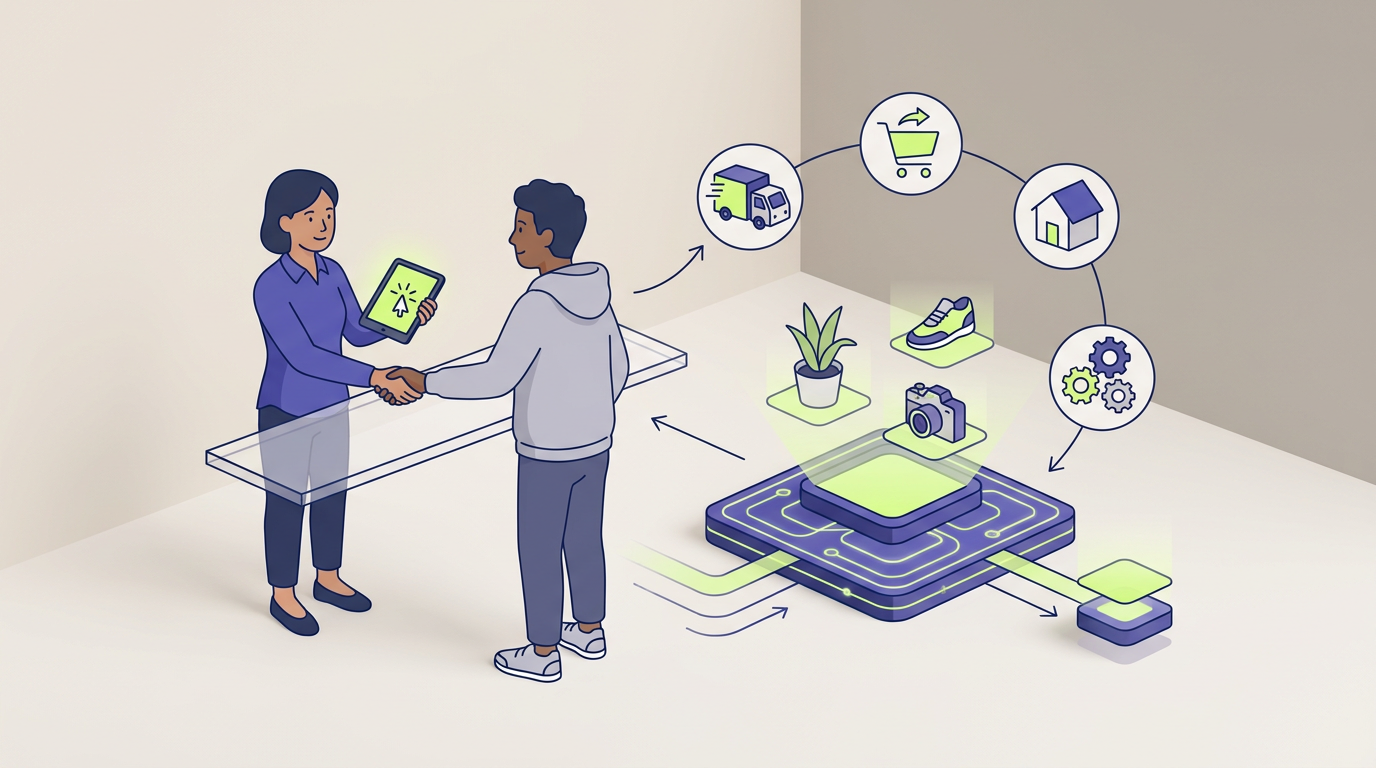
An online marketplace is a digital platform that connects buyers with independent sellers or service providers. The marketplace usually manages search, listings, payments, reviews, rules, and disputes, while third parties provide most of the products or services. Online marketplaces can support physical goods, digital products, rentals, courses, professional services, and peer-to-peer transactions.
The marketplace meaning is broader than online shopping. A marketplace does not simply display products on a website. A functioning platform must help different groups find one another, establish trust, complete transactions, and handle problems when an exchange fails.
Some marketplaces connect consumers with professional businesses. Others connect individuals with other individuals. A marketplace may also serve companies buying from suppliers, clients hiring service providers, or students purchasing digital courses from independent instructors.
What Is an Online Marketplace?
An online marketplace is a website or application where multiple independent providers offer goods, services, access, or digital content to potential buyers.
The platform normally creates the transaction infrastructure, but it does not necessarily manufacture, own, or deliver everything offered through the service.
An online marketplace may provide:
- seller accounts and storefronts;
- product or service listings;
- search and recommendation tools;
- price and availability information;
- payment processing;
- identity and account verification;
- ratings and reviews;
- order records;
- refund and dispute procedures;
- fraud and policy enforcement;
- advertising and promotional tools.
The defining feature is not the number of products displayed. The defining feature is that the platform coordinates transactions between different groups of users.
Online Marketplace vs Online Store
An online store normally sells products or services supplied by one business. An online marketplace allows multiple independent providers to participate through the same platform.
| Feature | Online marketplace | Online store |
|---|---|---|
| Number of sellers | Usually includes multiple independent sellers | Usually operated by one retailer or brand |
| Product ownership | The platform may not own the listed inventory | The store commonly owns or controls its inventory |
| Pricing | Individual sellers may set their own prices | The retailer usually determines prices |
| Transaction role | The platform coordinates buyers and sellers | The retailer sells directly to the customer |
| Revenue | Commissions, listing fees, payment fees, subscriptions, or advertising | Margin between the cost and selling price |
| Customer issue | Responsibility may be divided between seller and platform | The retailer is normally the main responsible party |
A company can operate both models. A website may sell its own inventory while also allowing third-party merchants to create listings.
How Does an Online Marketplace Work?
An online marketplace typically follows eight stages from seller registration to post-transaction support.
1. Providers Join the Platform
A seller, instructor, freelancer, property owner, or other provider creates an account and accepts the marketplace rules.
The platform may request:
- identity information;
- business registration details;
- bank or payment account information;
- tax information;
- licenses or qualifications;
- product safety documentation;
- contact and return details.
The amount of verification depends on the marketplace category, country, transaction risk, and applicable regulation.
2. The Provider Creates a Listing
The provider describes what is being offered and usually adds a price, images, availability, delivery terms, specifications, and other relevant conditions.
A physical-product listing may include size, material, shipping, and return information. A service listing may include experience, location, availability, scope, and completion time. A digital product may include file type, license, access period, or technical requirements.
3. The Platform Organizes Supply
The platform converts individual listings into a searchable catalog.
Search results may depend on:
- keyword relevance;
- category;
- price;
- location;
- availability;
- delivery speed;
- seller history;
- ratings;
- paid promotion;
- personalized recommendations.
The ranking system can influence which providers receive attention and which offers remain difficult to discover.
4. The Buyer Compares Offers
The buyer evaluates listings, prices, delivery terms, seller profiles, ratings, refund policies, and marketplace protections.
A marketplace reduces search costs by presenting fragmented supply through one interface. The buyer does not need to locate and contact every provider independently.
5. The Buyer Places an Order
The buyer selects an offer and submits the required transaction information.
The platform may calculate:
- the item or service price;
- delivery costs;
- taxes;
- buyer service fees;
- insurance or protection charges;
- currency conversion;
- discounts or credits.
6. The Marketplace Processes or Coordinates Payment
The marketplace may process the payment directly or use an external payment provider.
Money can be released immediately, held until shipment, delayed until service completion, or reserved during a dispute. The exact payment flow determines when the seller receives funds and what protection may be available to the buyer.
Our separate guide explains how a P2P transfer moves between users through payment applications and financial infrastructure.
7. The Provider Completes the Transaction
The seller ships a product, delivers a digital file, grants access, completes a service, or provides another promised outcome.
The marketplace may track shipment, deadlines, messages, acceptance, cancellation, or proof of completion.
8. The Platform Manages the Outcome
After completion, the platform may request reviews, calculate fees, release money, store transaction records, manage refunds, or investigate complaints.
This final stage is important because an online marketplace remains involved even when independent users provide the actual product or service.
What Is a Marketplace Platform?
A marketplace platform is the technical and operational system that coordinates interactions between different user groups.
The platform is not only a website template. It includes the rules, data, software, payment structure, moderation, ranking, and support processes required for repeated transactions.
A marketplace platform commonly contains:
- buyer and seller account systems;
- listing and inventory databases;
- search and recommendation engines;
- messaging tools;
- checkout and payment integration;
- commission and payout calculations;
- review and reputation systems;
- fraud detection;
- reporting and analytics;
- customer-support tools;
- dispute-resolution workflows.
A platform can use third-party software for some functions, but the marketplace operator remains responsible for deciding how the pieces work together.
What Is a Two-Sided Marketplace?
A two-sided marketplace connects two distinct groups that depend on the platform to interact.
The most common sides are:
- buyers and sellers;
- clients and service providers;
- borrowers and investors;
- students and instructors;
- property owners and renters;
- employers and freelancers.
The platform must provide value to both sides. Buyers need adequate choice, competitive offers, and reliable providers. Sellers need demand, useful tools, reasonable fees, and access to potential customers.
A marketplace can fail even when one side is satisfied. A platform with many listings but few buyers provides little value to sellers. A platform with many buyers but inadequate supply disappoints customers.
Why Network Effects Matter
Marketplaces can experience cross-side network effects. More sellers can create more selection for buyers, while more buyers can create more sales opportunities for sellers.
This feedback loop can support rapid growth, but it is not automatic. Low-quality listings, excessive duplication, fraud, poor search results, and slow support can make a larger marketplace less useful.
The platform must grow usable supply and qualified demand rather than simply increasing account numbers.
What Is a Multi-Vendor Marketplace?
A multi-vendor marketplace allows several sellers to operate through one website or application.
Each seller may have an independent profile, catalog, prices, inventory, delivery terms, and payout account. The marketplace provides shared infrastructure for discovery and transactions.
A multi-vendor model can apply to:
- physical retail products;
- handmade or specialist goods;
- wholesale supplies;
- restaurant delivery;
- software and applications;
- digital downloads;
- professional services;
- online courses.
The term describes how supply is organized. It does not determine whether the sellers are businesses or private individuals.
Major Types of Online Marketplaces
Business-to-Consumer Marketplace
A business-to-consumer marketplace connects professional sellers with individual buyers.
The platform may require business verification, consumer disclosures, product standards, delivery commitments, and formal return policies.
Consumer-to-Consumer Marketplace
A consumer-to-consumer marketplace allows individuals to sell, exchange, or rent items to other individuals.
A second hand marketplace online is a common example. Users list clothing, electronics, furniture, collectibles, vehicles, or household items that they no longer need.
Peer-to-Peer Marketplace
A peer-to-peer marketplace connects users who provide goods, services, money, access, or unused capacity to one another.
The marketplace may still manage accounts, payments, matching, reviews, rules, and disputes. Peer-to-peer does not necessarily mean that the platform has no control.
Our main guide explains the peer-to-peer platform model across networks, payments, and digital services.
Business-to-Business Marketplace
A business-to-business marketplace connects companies with suppliers, manufacturers, wholesalers, contractors, or professional service providers.
Transactions may involve larger order values, negotiated prices, purchase approvals, invoices, credit terms, and recurring supply relationships.
Online Service Marketplace
An online service marketplace connects customers with individuals or companies that provide work rather than physical inventory.
Examples include:
- freelance work;
- home maintenance;
- consulting;
- design;
- transportation;
- tutoring;
- health and wellness services;
- local appointments.
The marketplace must describe what is included, when the service is complete, how quality is evaluated, and how disagreements are resolved.
Digital Product Marketplace
A digital product marketplace sells files, licenses, templates, software, music, photographs, designs, or other downloadable products from multiple creators.
The platform may manage file hosting, delivery, licenses, updates, copyright complaints, and payment distribution.
Online Course Marketplace
Online course marketplaces connect instructors with learners. Instructors create educational content, while the platform provides hosting, search, enrollment, payment, and learner-account tools.
The platform may control prices, promotions, completion certificates, refunds, and access periods.
Rental Marketplace
A rental marketplace gives users temporary access to accommodation, vehicles, equipment, storage, clothing, or other assets.
Availability, deposits, condition evidence, insurance, damage rules, and return procedures become central platform functions.
Financial Marketplace
A financial marketplace connects users seeking capital or financial products with lenders, investors, or providers.
Peer-funded lending is one example. Our dedicated article explains how peer to peer lending platforms work.
How Do Online Marketplaces Make Money?
An online marketplace normally earns revenue by charging for access to transactions, demand, software, or supporting services.
| Revenue model | How it works | Who usually pays? |
|---|---|---|
| Transaction commission | The platform keeps a percentage of a completed sale | Seller, buyer, or both |
| Listing fee | A provider pays to publish an offer | Seller or service provider |
| Payment-processing fee | The platform charges for accepting and distributing payment | Seller or buyer |
| Subscription | Users pay recurring fees for tools or access | Professional sellers or buyers |
| Advertising | Providers pay for greater visibility | Sellers or brands |
| Lead fee | A provider pays to receive a customer inquiry | Service provider |
| Service fee | A fixed or variable charge is added to an order | Buyer, provider, or both |
| Optional services | The platform sells shipping, analytics, insurance, or other tools | Users selecting the service |
A marketplace can combine several revenue streams. The visible commission may represent only part of the total cost paid by users.
Marketplace operators often track gross merchandise value, or GMV. GMV represents the total value of transactions completed through the platform before the marketplace recognizes its own revenue.
The take rate compares marketplace revenue with transaction value. A platform that processes $100 in sales and retains $10 in net revenue has an illustrative take rate of 10%.
Real Marketplace Revenue Structures
Public company filings show that mature marketplaces rarely depend on only one fee.
Etsy reported that its 2025 marketplace revenue included transaction fees, payment-processing fees, listing fees, and offsite advertising charges. The company also earned services revenue from optional tools such as on-site advertising and shipping labels.
eBay reported nearly $80 billion in GMV during 2025, with 135 million active buyers and approximately 2.5 billion live listings at year-end. Its filing explains that revenue primarily comes from commissions on marketplace transactions and fees charged to sellers for promoting listings.
These examples demonstrate the difference between marketplace sales volume and marketplace revenue. Most of the value paid by buyers belongs to sellers, tax authorities, delivery providers, and other participants rather than becoming platform income.
How Online Marketplaces Build Trust
Buyers and sellers often begin a transaction without knowing one another. The marketplace must reduce uncertainty sufficiently for both sides to participate.
Identity and Seller Verification
The platform may verify names, addresses, documents, payment accounts, business registrations, telephone numbers, or tax details.
Verification cannot guarantee honest behavior, but it can make anonymous abuse more difficult and improve accountability.
Ratings and Reviews
Reviews provide information about previous transactions. Buyers can examine delivery, quality, communication, accuracy, and problem resolution.
Ratings are useful but imperfect. Fake reviews, incentives, selective publication, retaliation, and rating inflation can distort the result.
Payment Protection
The platform may delay payouts, retain reserves, process refunds, or release funds only after specified conditions are met.
Marketplace Rules
Rules can prohibit illegal goods, misleading listings, manipulation, harassment, off-platform payments, intellectual-property violations, and other harmful behavior.
Dispute Resolution
A marketplace may collect messages, payment records, shipment tracking, photographs, and other evidence before deciding whether to refund a buyer or pay a seller.
Moderation and Fraud Detection
Automated systems and human reviewers may examine unusual activity, duplicate accounts, suspicious payments, prohibited listings, and manipulated feedback.
Why Seller Traceability Matters
Seller identity is becoming a more important marketplace obligation.
Under the European Union’s Digital Services Act, covered online marketplaces that allow consumers to conclude contracts with traders must collect specified trader information before allowing those traders to offer products or services.
The information can include:
- the trader’s name and contact details;
- identification documentation;
- payment-account information;
- business-registration details;
- a commitment to offer products or services that comply with applicable rules.
The platform must also make reasonable efforts to assess whether the submitted information is reliable and complete.
The practical lesson applies beyond one jurisdiction: a marketplace cannot build long-term trust while treating seller identity as irrelevant.
NINKI INSIGHT: A Marketplace Is a Transaction System, Not a List of Sellers
The weakest marketplace idea is “a website where users can create listings.” Listings create supply, but they do not create reliable transactions. A real marketplace must solve discovery, trust, payment, fulfillment, responsibility, and repeat usage at the same time.
A directory can display providers without controlling what happens next. A marketplace becomes more valuable when it reduces the risk and effort involved in completing the exchange.
The strongest marketplace function may be different in each category:
- a second-hand platform may focus on shipping and payment protection;
- a service marketplace may focus on identity, scheduling, and proof of completion;
- a rental platform may focus on availability, deposits, and damage disputes;
- a digital product marketplace may focus on licensing and file delivery;
- a lending marketplace may focus on underwriting, servicing, and repayment records.
The platform should therefore be designed around the transaction’s most difficult point rather than around a generic collection of listings.
Common Marketplace Failure Modes
Too Much Supply and Not Enough Demand
A marketplace may recruit many sellers before developing a reliable buyer-acquisition channel. Providers then receive little activity and stop maintaining their listings.
Too Much Demand and Inadequate Supply
Customers arrive but cannot find suitable prices, locations, availability, quality, or delivery times. The platform spends money acquiring users who leave without completing a transaction.
Low-Quality or Duplicate Listings
A large catalog can reduce usability when search results contain outdated, misleading, copied, or repetitive offers.
Weak Trust Controls
Fraud, fake reviews, hidden seller identities, unreliable providers, and poor dispute handling can damage confidence across the entire marketplace.
Unclear Fees
A low headline commission can be misleading when payment, withdrawal, advertising, delivery, currency, and service charges are added later.
Unclear Responsibility
Buyers may not know whether the seller, platform, payment processor, or delivery company is responsible for a failed transaction.
Forcing Transactions Off the Platform
Users may avoid marketplace fees by communicating or paying elsewhere. The platform then loses revenue, transaction data, fraud visibility, and the ability to provide protection.
Ranking Based Only on Paid Promotion
A marketplace that prioritizes advertising over relevance can reduce buyer satisfaction and reward providers with the largest promotional budgets rather than the best offers.
How to Evaluate an Online Marketplace
- Identify the seller. Determine whether the provider is a business or a private individual.
- Read the complete price. Include delivery, taxes, payment charges, service fees, subscriptions, and withdrawal costs.
- Check payment protection. Confirm what happens if the product does not arrive or the service is not completed.
- Review return and cancellation rules. Marketplace protection may differ by product, seller, or transaction type.
- Examine reviews critically. Look beyond the average score and check recent negative feedback.
- Confirm who handles disputes. Determine whether the platform investigates complaints or simply refers users to the seller.
- Check seller verification. A verified badge may cover identity, business details, payment ownership, or only one limited check.
- Review communication rules. Moving conversations or payments off-platform can remove protection.
- Check data and account security. Look for strong authentication and clear account-recovery procedures.
- Consider marketplace stability. Understand what happens to orders, balances, files, or records if the platform becomes unavailable.
Frequently Asked Questions
What is an online marketplace in simple terms?
An online marketplace is a website or application where multiple independent sellers or providers offer goods, services, rentals, or digital content to potential buyers.
What is the difference between a marketplace and e-commerce?
E-commerce covers online commercial transactions generally. A marketplace is a specific e-commerce model that connects multiple independent providers with buyers through shared platform infrastructure.
What is a digital marketplace?
A digital marketplace is an online platform that organizes transactions between different user groups. It may offer physical products, digital goods, professional services, rentals, courses, or financial products.
What is an online service marketplace?
An online service marketplace connects customers with independent professionals or businesses that provide work, expertise, transportation, appointments, or other services.
What is a peer-to-peer marketplace?
A peer-to-peer marketplace enables individual users to exchange goods, services, access, money, or unused capacity with other users through a coordinating platform.
What is a two-sided marketplace?
A two-sided marketplace connects two distinct user groups, such as buyers and sellers, that receive greater value when the platform attracts suitable participants on the other side.
What is a multi-vendor marketplace?
A multi-vendor marketplace allows multiple independent sellers to create listings and receive orders through one shared website or application.
How does an online marketplace make money?
Online marketplaces commonly earn transaction commissions, listing fees, payment-processing charges, subscriptions, service fees, advertising revenue, or fees for optional seller tools.
Does an online marketplace own the products?
Not necessarily. Many marketplace platforms coordinate sales between buyers and independent sellers without owning the listed inventory.
Are marketplace reviews always reliable?
No. Reviews can be useful, but fake feedback, incentives, selective publication, and rating manipulation can affect reliability. Buyers should examine several trust signals rather than relying only on an average score.
Final Summary
An online marketplace connects buyers with independent sellers, service providers, creators, property owners, instructors, or other sources of supply.
The platform creates value by organizing listings, improving discovery, processing or coordinating payments, establishing rules, building reputation systems, and handling failed transactions.
Marketplaces can serve consumers, businesses, individuals, service providers, digital creators, renters, borrowers, and investors. Common structures include two-sided platforms, multi-vendor marketplaces, peer-to-peer platforms, service marketplaces, digital product marketplaces, and second-hand markets.
A marketplace should not be evaluated only by the size of its catalog. The more important questions are whether buyers can find suitable offers, whether providers can reach qualified demand, whether fees are transparent, and whether the platform can manage trust and responsibility when something goes wrong.
The central principle is simple: listings attract attention, but reliable transaction infrastructure creates a sustainable marketplace.