
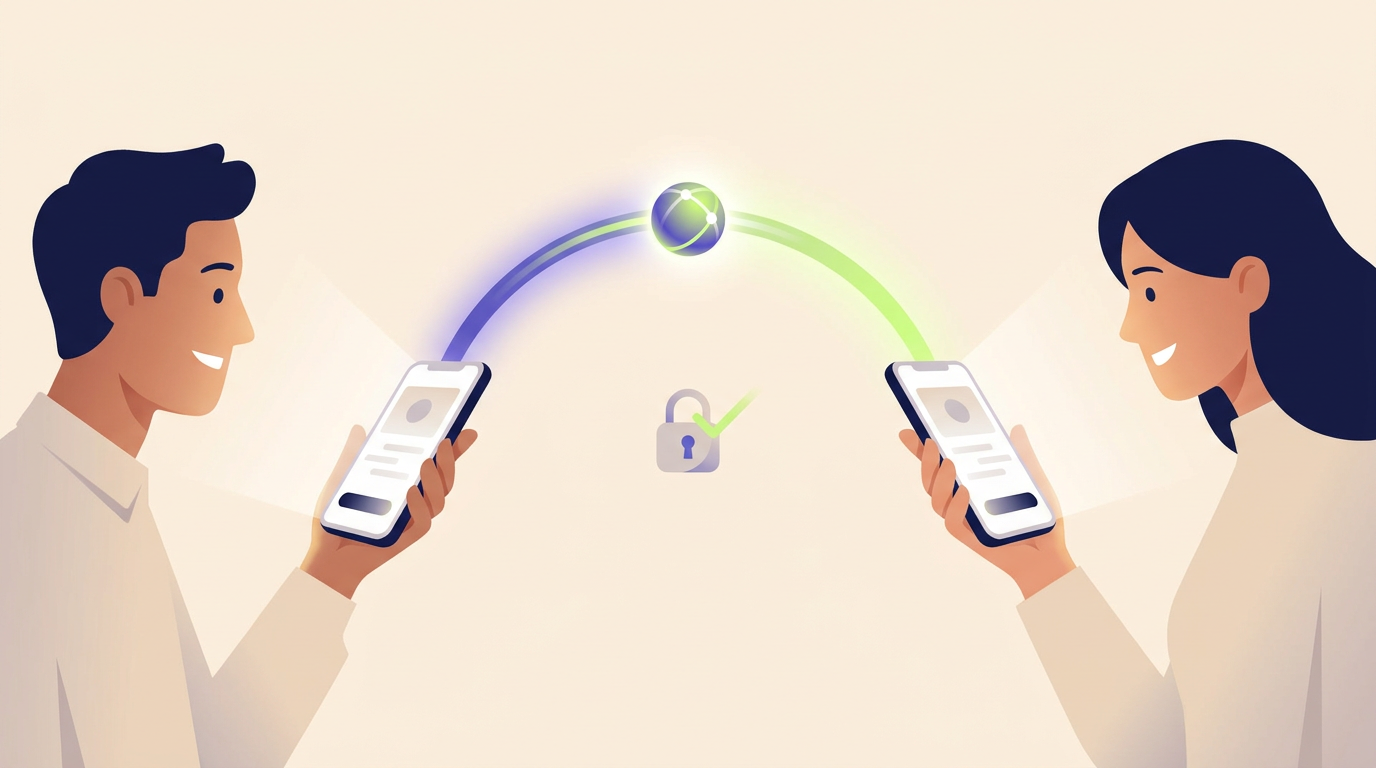
A P2P transfer is a digital payment from one person to another through a bank, wallet, or payment application. The sender identifies the recipient, enters an amount, and authorizes the transaction. The service then moves the funds using an internal balance, bank transfer, card network, or instant-payment system.
The abbreviation P2P can mean either peer-to-peer or person-to-person in the payments industry. Both expressions describe a payment in which one user sends money directly to another user rather than paying a traditional merchant at a checkout.
The experience may look simple, but the transaction can involve several organizations behind the screen. Banks, payment processors, card networks, fraud-monitoring systems, account directories, and settlement infrastructure may all participate in a single transfer.
For a broader explanation of the business model, read our guide to how P2P platforms work.
What Is a P2P Transfer?
A P2P transfer is an electronic movement of money between two individuals. The sender initiates the payment through a bank website, banking application, digital wallet, or specialist money-transfer service.
The recipient may be identified through:
- a mobile telephone number;
- an email address;
- a bank account number;
- a payment username;
- a digital wallet address;
- a QR code;
- a saved contact inside an application.
A P2P payment is commonly used to split a restaurant bill, repay a friend, send money to a family member, pay an individual service provider, or transfer funds between personal accounts.
The P2P label describes the relationship between the sender and recipient. It does not identify the specific technology moving the money.
P2P Payment Meaning vs P2P Transfer Meaning
The terms P2P payment and P2P transfer are often used interchangeably. Both describe money moving from one person to another.
However, the word “payment” usually emphasizes the purpose of the transaction, while “transfer” emphasizes the movement of funds.
| Term | Typical meaning | Example |
|---|---|---|
| P2P payment | A person pays another person for a personal obligation, purchase, or shared expense | Paying a friend for part of a hotel booking |
| P2P transfer | Money moves from one user’s account or wallet to another | Sending money to a family member |
| Bank transfer | Funds move between bank accounts using banking infrastructure | Transferring money using an account number |
| Wallet transfer | Funds move between balances maintained by a payment application | Sending part of an application balance to another user |
| QR P2P transfer | The sender identifies the recipient by scanning a personal QR code | Scanning a friend’s QR code and authorizing payment |
The same transaction can fit more than one definition. A person-to-person payment funded from a bank account is also a bank transfer from the infrastructure perspective.
How Does a P2P Transfer Work?
Most peer-to-peer payments follow seven operational stages. Some stages appear instantly to the user, while others occur inside banking and payment systems.
1. The Sender Selects a Recipient
The sender searches for the recipient using a telephone number, email address, username, bank account, contact list, or QR code.
The application may display a name, profile image, partial account information, or other confirmation details. The sender should verify these details before continuing.
2. The Sender Enters the Payment Amount
The sender enters the amount and may add a short description explaining the purpose of the payment.
The application may also display:
- the available balance;
- the funding source;
- estimated fees;
- delivery speed;
- daily or transaction limits;
- the expected arrival time.
3. The Sender Chooses a Funding Source
A P2P transfer can be funded from several sources:
- a balance stored inside the payment application;
- a current or checking account;
- a savings account;
- a debit card;
- a credit card, where permitted;
- a linked digital wallet.
The funding source can affect the fee, speed, legal protections, and possibility of reversing the transaction.
4. The User Authorizes the Transfer
The sender confirms the transaction using a password, personal identification number, fingerprint, face recognition, one-time code, or another authentication method.
Authorization proves that the payment instruction came through the sender’s account. It does not necessarily prove that the recipient is trustworthy or that the underlying request is legitimate.
5. The Service Performs Risk Checks
The bank or payment provider may examine the transaction before processing it.
Risk checks can consider:
- the sender’s device and location;
- recent account activity;
- the payment amount;
- the recipient’s account history;
- unusual login behavior;
- transaction velocity;
- known fraud patterns;
- compliance and sanctions requirements.
A transfer may be approved immediately, delayed for review, rejected, or subject to an additional authentication request.
6. Clearing and Settlement Take Place
Clearing and settlement are related but different processes.
Clearing involves exchanging and validating payment information. Clearing can include confirming the sender, recipient, amount, payment instruction, and fraud-screening result.
Settlement is the actual financial movement that debits one account and credits another account.
The application may show the payment as complete before every behind-the-scenes settlement step has finished. This is why “sent,” “available,” and “finally settled” do not always mean exactly the same thing.
7. The Recipient Receives the Funds
The recipient may receive the money in a bank account, payment-app balance, card-linked account, or digital wallet.
Some services make the funds available almost immediately. Others require the recipient to accept the payment, verify an account, or transfer the balance manually to a bank.
Which Payment Network Moves the Money?
A P2P application is not always the payment network itself. The application can provide the user interface while another system performs the financial transfer.
| Payment method | How it works | Possible effect on the user |
|---|---|---|
| Internal ledger | The provider updates balances held within its own system | The transfer may appear immediate between users of the same service |
| ACH or batch bank transfer | Payment instructions are processed through a bank transfer network | Final movement may take longer than the application notification |
| Debit card network | The payment is funded or delivered through a linked debit card | Delivery may be faster but additional fees can apply |
| Instant-payment rail | Participating financial institutions clear and settle funds in near real time | The recipient may receive usable funds within seconds |
| QR-based credit transfer | A QR code supplies the recipient’s payment information | The sender avoids typing a username or account number |
Federal Reserve payment data show how quickly P2P use expanded in the United States. In 2021, users initiated approximately 2 billion person-to-person transfers through depository institutions’ websites and applications, with a total value of about $0.45 trillion. Approximately 73% made funds available to recipients within 30 minutes.
Fast-payment infrastructure is also expanding internationally. More than 120 fast-payment systems were operating around the world by 2024, although their access models, fees, transaction limits, and technical designs differ.
Common P2P Payment Examples
Splitting a Shared Expense
One person pays a restaurant, hotel, taxi, or entertainment bill and the other participants send their portions through a payment application.
Sending Money to Family
A user sends money to a parent, child, partner, or other family member without exchanging cash or visiting a bank branch.
Repaying a Friend
A borrower repays a small informal debt after another person covered a purchase or expense.
Paying an Individual Seller
A buyer sends money to an individual selling a used item through a marketplace or local listing.
This use requires additional caution because a basic P2P transfer may not provide the same dispute or chargeback process as a card purchase from a merchant.
Paying a Service Provider
A person may pay a tutor, cleaner, repair worker, freelancer, or another independent provider through a P2P application.
QR Code Transfer
The recipient displays a personal QR code and the sender scans it with a banking or payment application.
Malaysia’s DuitNow QR system, for example, supports person-to-person transfers in which the sender scans the recipient’s QR code. This is a specific national payment system rather than a general meaning of the P2P transfer keyword.
Is a P2P Transfer Instant?
A P2P transfer can be instant, but not every transfer is settled instantly.
Payment speed depends on:
- the provider;
- the funding source;
- the receiving institution;
- the payment network;
- the time and day;
- fraud or compliance reviews;
- whether the recipient has completed registration;
- whether the recipient wants an instant or standard withdrawal.
An application may show the recipient a provisional balance while the underlying bank transfer is still processing. Conversely, an instant-payment rail can complete clearing and settlement within seconds.
Users should check whether the provider is describing:
- the time until the recipient receives a notification;
- the time until a balance appears in the application;
- the time until money can be spent;
- the time until funds reach an external bank account;
- the time until settlement becomes final.
How Much Does a P2P Payment Cost?
Many standard P2P transfers are free, but charges can apply depending on how the payment is funded and delivered.
| Possible charge | When it may apply |
|---|---|
| Instant-transfer fee | The user moves an application balance to a bank account immediately |
| Card funding fee | The payment is funded with a credit card or certain debit cards |
| Currency conversion fee | The sender and recipient use different currencies |
| Cross-border fee | The payment moves between countries or payment systems |
| Business transaction fee | The recipient is classified as a merchant or commercial account |
| Account withdrawal fee | The recipient transfers money out of a wallet or platform balance |
A free transfer is not always the fastest transfer. The provider may offer standard delivery without a fee and charge for immediate withdrawal.
Are P2P Transfers Safe?
P2P transfers can be secure when the account, device, recipient, and payment request are legitimate. The largest risk is often not the payment technology itself but the possibility that a user sends money to the wrong person or follows instructions from a scammer.
Wrong Recipient
A similar username, old telephone number, incorrect account detail, or wrong QR code can direct the money to another person.
Impersonation Scam
A criminal may impersonate a friend, relative, bank employee, government representative, or customer-support agent and request an urgent payment.
Account Takeover
A criminal may gain access through a stolen password, compromised email account, intercepted verification code, malicious application, or data breach.
Fake Payment Request
A user may receive a request that appears to come from a known contact. The contact’s account may have been compromised, or the displayed name may be misleading.
Marketplace Scam
A fake seller may request a P2P payment for an item that does not exist. A fraudulent buyer may send a fake payment confirmation and pressure the seller to release the product.
Overpayment Scam
A scammer may claim to have sent too much money and ask for part of it to be returned. The original payment may be fake, unauthorized, or later reversed.
Payment-App Balance Risk
Money stored in a payment application may not receive the same deposit protection as funds held directly in an insured bank account. Protection depends on the provider, account structure, jurisdiction, and whether the provider places customer funds in an eligible custodial account.
Authorized Scam vs Unauthorized Transfer
The distinction between an authorized scam payment and an unauthorized transfer can affect the user’s rights.
An unauthorized transfer may occur when another person accesses an account and initiates a payment without the account holder’s permission.
An authorized scam payment occurs when the account holder personally confirms the payment after being deceived about the recipient or reason for sending money.
These situations may look similar from the victim’s perspective, but banks, payment providers, and laws may treat them differently.
In the United States, Consumer Financial Protection Bureau guidance states that a credit-push P2P payment initiated by a third party using stolen account credentials can qualify as an unauthorized electronic fund transfer. The result of a specific dispute still depends on the facts and applicable law.
Users should report suspected fraud immediately instead of assuming that a payment cannot be investigated.
Can a P2P Transfer Be Reversed?
A completed P2P transfer may be difficult to reverse, especially when the sender knowingly authorized it and the recipient has already received or withdrawn the funds.
Reversal possibilities depend on:
- whether the payment is pending or completed;
- whether the recipient has accepted it;
- whether the recipient account exists;
- whether the payment was unauthorized;
- whether the provider can freeze the funds;
- the funding method;
- the payment network’s rules;
- the provider’s dispute policy;
- local consumer-protection law.
A cancellation button may be available when a payment remains unclaimed. Once a valid recipient accepts or receives the money, the sender may need the recipient’s cooperation to recover it.
What to Do After Sending Money to the Wrong Person
- Check the transaction status. Determine whether the payment is pending, completed, or awaiting acceptance.
- Use the cancellation option immediately. Cancel the transfer if the provider still permits it.
- Contact the payment provider. Report the mistake and request assistance.
- Contact the bank or card issuer. Explain how the transaction was funded and ask which dispute options apply.
- Contact the recipient carefully. Use the application’s official communication tools when possible.
- Save all evidence. Keep transaction numbers, dates, messages, screenshots, and recipient details.
- Report suspected fraud. Notify the appropriate provider and public authority in your jurisdiction.
Acting quickly matters because the recipient may withdraw or transfer the funds before the provider investigates.
NINKI INSIGHT: P2P Is an Interface, Not Necessarily a Payment Rail
The most useful way to understand a P2P payment is to separate the user experience from the underlying infrastructure. The application may make two people appear directly connected, while banks, card networks, payment processors, fraud systems, and settlement services complete the transaction behind the interface.
This distinction explains why two payments made through the same application can have different fees, speeds, and protections.
A transfer funded from an internal balance may update instantly inside the provider’s ledger. A bank-funded payment may depend on a batch transfer system. A card-funded payment may follow card-network rules. An instant bank payment may settle through a real-time infrastructure.
The P2P payment meaning therefore describes who is paying whom, not necessarily how the money travels.
Common P2P Transfer Mistakes
Sending Money Before Confirming the Recipient
A user should not rely only on a profile picture or display name. Telephone numbers can be reassigned, accounts can be compromised, and usernames can be similar.
Treating a P2P App Like a Credit Card
Some P2P payments have limited purchase protection. A transfer to an unknown seller may be closer to sending cash than making a conventional card purchase.
Believing Every Urgent Request
Scammers create urgency to prevent verification. A request to move money immediately, protect an account, pay a fine, or help a relative should be confirmed through a trusted communication channel.
Sharing Authentication Codes
A bank or payment provider should not need the user to reveal a one-time login or authorization code to receive a payment.
Trusting Screenshots as Proof of Payment
A screenshot can be edited or generated without a completed transaction. Sellers should confirm receipt through their own account.
Leaving Large Balances in an Application
A wallet balance may have different protection, access, and withdrawal conditions from a regulated deposit account.
Ignoring Fees and Limits
A transfer can fail or become expensive when the sender exceeds a daily limit, uses a fee-based funding source, or requests immediate withdrawal.
How to Use P2P Payments More Safely
- Confirm the recipient independently. Check the telephone number, email, username, or QR details before authorizing the payment.
- Send a small test payment when appropriate. A test can reduce the impact of an incorrect recipient or account detail.
- Enable multifactor authentication. Protect both the payment account and the email account connected to it.
- Use a unique password. Do not reuse the same password across payment, email, and social-media accounts.
- Review every payment request. Contact the person through a known telephone number when a request is unexpected.
- Avoid unknown sellers. Use a payment method with appropriate purchase protection for commercial transactions.
- Check account activity regularly. Report unrecognized payments promptly.
- Keep the application updated. Security updates can address known vulnerabilities.
- Review the funding source. Understand which bank account, card, or balance will be charged.
- Do not disclose verification codes. Authentication codes should remain private.
P2P Transfer vs Peer-to-Peer Lending
A P2P transfer moves existing money from one person to another. Peer-to-peer lending creates a debt that the borrower is expected to repay over time.
| Feature | P2P transfer | Peer-to-peer lending |
|---|---|---|
| Main purpose | Move money between users | Provide financing to a borrower |
| Repayment obligation | Normally none after the payment is complete | The borrower must repay principal and usually interest |
| Typical duration | Seconds, minutes, or days | Months or years |
| Main risk | Fraud, wrong recipient, account compromise, or transfer failure | Borrower default, platform failure, liquidity, and credit risk |
| Return to sender | No investment return is expected | The investor may expect interest |
Our separate guide explains how peer to peer lending works, including investor returns, defaults, and platform risks.
Frequently Asked Questions
What is a P2P transfer in simple terms?
A P2P transfer is an electronic payment from one person to another through a bank, digital wallet, or payment application.
What is a P2P payment?
A P2P payment is a person-to-person transaction used to send money to a friend, family member, individual seller, service provider, or another personal contact.
Is a P2P payment the same as a bank transfer?
Not always. A P2P application may use a bank transfer, card network, instant-payment rail, or its own internal balance system to move the money.
How long does a P2P transfer take?
Some transfers make funds available within seconds, while others take several business days. Speed depends on the provider, funding source, receiving institution, and payment network.
Can I cancel a P2P payment?
A pending or unclaimed payment may be cancellable. A completed payment to a registered recipient can be difficult to reverse without the recipient’s cooperation or a valid fraud claim.
Are P2P transfers free?
Many standard transfers are free. Fees may apply for card funding, instant withdrawal, international transfers, currency conversion, or business payments.
Are P2P payment apps safe?
Payment apps can use strong security controls, but users still face risks from scams, account takeover, wrong recipients, fake payment requests, and weak passwords.
What is a QR P2P transfer?
A QR P2P transfer allows the sender to scan a code containing the recipient’s payment details instead of entering an account number, email address, or username manually.
What should I do if a P2P transfer was fraudulent?
Contact the payment provider and linked bank or card issuer immediately. Save the transaction details, secure the account, change compromised passwords, and report the fraud through the appropriate local channels.
Final Summary
A P2P transfer moves money electronically from one person to another through a bank, wallet, or payment application.
The user experience may appear direct, but the underlying transaction can involve account authentication, fraud checks, clearing, settlement, bank networks, card systems, and payment processors.
Transfer speed, fees, withdrawal rules, reversibility, and legal protections depend on the provider and funding method.
Users should confirm the recipient, understand the payment status, protect authentication credentials, and avoid using cash-like P2P transfers for unfamiliar sellers when appropriate purchase protection is unavailable.
The most important principle is simple: a fast and convenient interface does not remove the need to verify who is receiving the money and why the payment is being requested.