
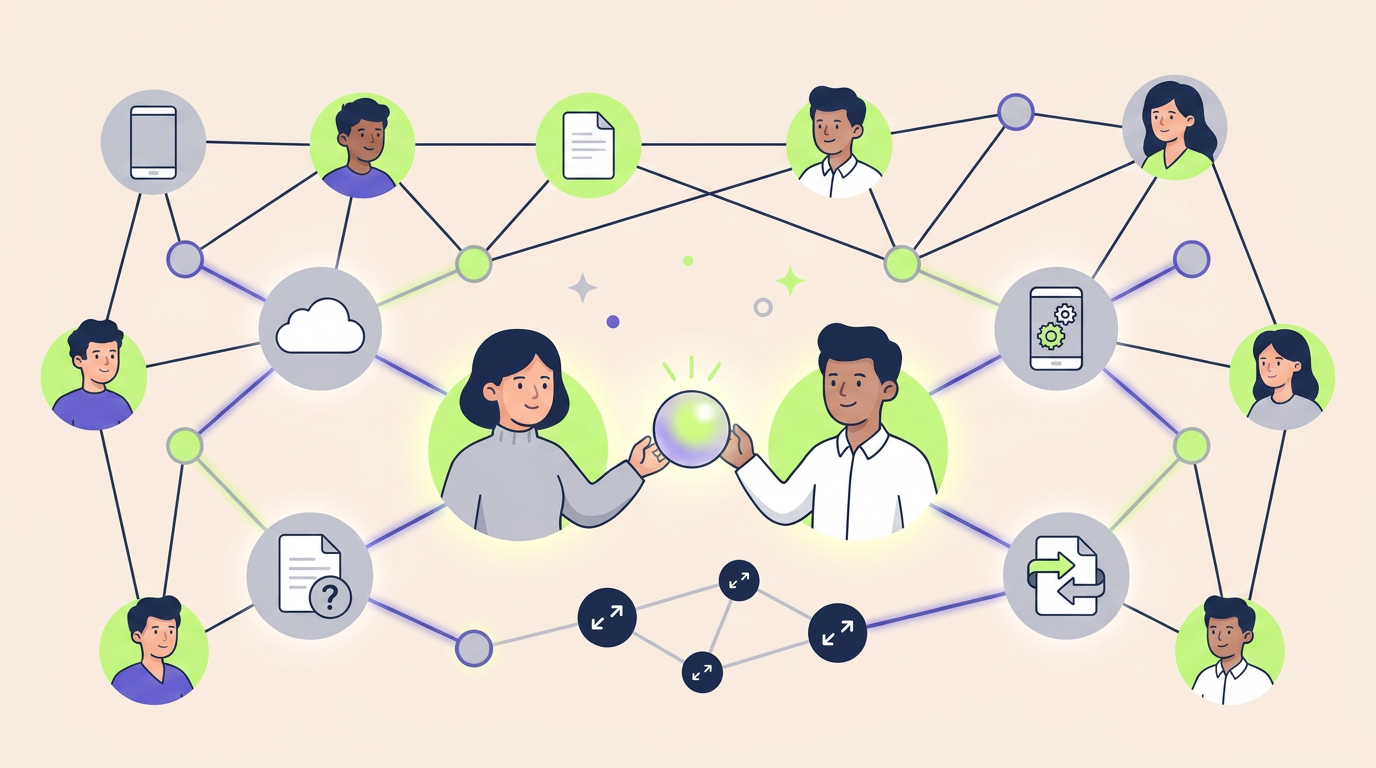
Peer to peer, usually shortened to P2P, describes a system in which participants exchange data, money, goods, access, or services with other participants. The term can refer to computer networks, payments, lending, marketplaces, rentals, and digital platform business models. A digital platform may still coordinate and control the transaction.
The meaning of P2P changes slightly depending on the context. In computing, two devices may exchange data directly. In finance, one person may send money or provide funding to another. In an online marketplace, individual users may buy, sell, lend, or rent goods and services through a platform.
The central idea remains the same: participants on both sides of the system contribute value. The platform does not necessarily own the money, product, accommodation, vehicle, file, or service being exchanged.
What Does P2P Mean?
P2P means peer-to-peer. A peer is a participant with a role comparable to another participant in the same network or transaction.
In a conventional business model, a company usually creates a product or service and sells it to customers. In a peer-to-peer business model, the company may instead provide the infrastructure that allows users to exchange value with one another.
The platform can supply software, payment processing, identity verification, search tools, reputation systems, customer support, transaction records, and dispute procedures. The underlying product or service may still come from another user.
| Context | P2P meaning | Typical exchange |
|---|---|---|
| Computer network | Devices communicate and share resources with other devices | Files, bandwidth, storage, or processing capacity |
| Payments | One person sends money to another person | Money transferred through a bank or payment application |
| Lending | Investors or lenders provide funds to borrowers through a platform | Capital in exchange for scheduled repayments and interest |
| Marketplace | Individuals buy, sell, rent, or provide services to other users | Goods, accommodation, vehicles, labour, or digital services |
| Platform economy | A business coordinates transactions between different user groups | Access, matching, trust, payments, and transaction management |
How Does Peer-to-Peer Work?
A P2P system usually follows five stages. The exact process depends on whether the system handles data, money, credit, products, or services.
1. Participants Join the Network
Users create an account, connect a device, register a payment method, publish a listing, or otherwise become available to other participants.
A computer may join a file-sharing network. A seller may list a used product. A borrower may submit a funding request. A user may activate a payment account for transfers between friends.
2. The System Finds a Match
A peer-to-peer platform reduces the cost and effort required to locate another participant. Search tools, filters, algorithms, location data, prices, availability, risk criteria, or user preferences may determine which participants are shown to each other.
Matching is one of the most valuable platform functions. Without a matching system, users would have to find suitable counterparties independently and establish whether they could be trusted.
3. The Platform Establishes Trust
Most digital P2P systems use trust mechanisms because the participants often have no previous relationship.
Trust mechanisms may include:
- identity verification;
- account authentication;
- ratings and reviews;
- payment verification;
- credit assessment;
- transaction limits;
- security monitoring;
- escrow or delayed payment release;
- refund and dispute procedures.
A European Commission research review examined more than 100 collaborative platforms and identified ratings as one of the main trust and quality mechanisms used by platforms. The review also noted that evidence about the reliability of platform-controlled reputation systems remained limited.
4. The Participants Exchange Value
The exchange may involve money, data, access to an asset, a service, processing capacity, or another resource.
Some exchanges occur directly between participants. Other exchanges pass through payment processors, banks, cloud systems, escrow accounts, or platform-controlled infrastructure.
5. The Platform Records and Manages the Outcome
After the transaction, the platform may create receipts, update account balances, request reviews, release funds, calculate fees, store records, monitor suspicious activity, or provide a dispute process.
This final stage demonstrates why a modern P2P transaction is rarely completely unmediated. The platform may not provide the underlying asset, but it often manages almost every operational step around the exchange.
How Does a Peer-to-Peer Network Function?
A peer-to-peer network allows connected computers or devices to act as both users and providers of network resources.
In a traditional client-server model, a central server provides data or services to multiple client devices. In a pure P2P network, each participating device can request information and also provide information to another device.
A peer may contribute:
- files;
- bandwidth;
- storage space;
- processing power;
- network routing;
- data availability.
The main advantage of a distributed peer-to-peer network is that resources can be spread across multiple devices. The system may continue operating even when one participant becomes unavailable.
The main limitation is that distributed participation can make quality control, security, coordination, availability, and accountability more difficult. A network must decide how peers are discovered, how data is verified, how malicious activity is handled, and what happens when a participant disconnects.
Pure P2P Networks vs Hybrid P2P Networks
A pure P2P network has little or no central coordination. Devices locate and communicate with one another using distributed protocols.
A hybrid P2P network combines direct communication with centralized services. A central system may manage accounts, indexes, search, authentication, or peer discovery while the actual resource exchange occurs between devices.
Many commercial services described as P2P are hybrid systems because centralized coordination makes the user experience easier to manage.
What Is P2P Meaning in Finance?
In finance, P2P describes a transaction or funding relationship between individuals or organizations that is facilitated by digital infrastructure.
The most common financial uses are:
- person-to-person payments;
- peer-to-peer lending;
- crowdfunding;
- marketplace financing;
- money transfers between payment accounts;
- direct transactions between digital wallets.
The phrase does not necessarily mean that banks or payment companies are absent. A transfer that appears direct to the user may still depend on a bank account, payment service provider, fraud-monitoring system, messaging standard, and settlement infrastructure.
P2P Meaning in Banking
In banking, P2P usually refers to a person-to-person transfer initiated through a mobile application, banking interface, phone number, email address, QR code, or account identifier.
The sender selects a recipient and authorizes the payment. The banking or payment infrastructure then verifies the instruction, moves or settles the funds, updates balances, and produces a transaction record.
Fast payment systems increasingly support P2P transfers. According to the Bank for International Settlements, India processed 48.6 billion fast payments in 2022, followed by China with 16.6 billion, Thailand with 9.7 billion, and Brazil with 8.7 billion. Not every fast payment is a P2P payment, but person-to-person transfers are an important use case for this infrastructure.
P2P Transfer Meaning
A P2P transfer moves money from one person’s account or wallet to another. Our guide explains how a P2P transfer works, including settlement, fees, reversals, and fraud risks.
The recipient may be identified by:
- a bank account number;
- a telephone number;
- an email address;
- a payment username;
- a QR code;
- a digital wallet address.
A simple interface can make the payment look immediate, but the underlying transaction may involve authentication, compliance checks, fraud controls, payment messaging, and final settlement.
What Is a Peer-to-Peer Marketplace?
A peer-to-peer marketplace is an online platform that helps users transact with other users. The platform usually does not manufacture or own every product offered through the marketplace.
Common P2P marketplace categories include:
- second-hand goods;
- short-term rentals;
- vehicle sharing;
- freelance services;
- equipment rental;
- accommodation;
- local services;
- digital products.
A marketplace can create value by making fragmented supply searchable. A person with an unused item, available room, specific skill, or spare capacity can reach users who need that resource.
What the Marketplace Actually Provides
A successful marketplace provides more than a page of listings. The platform may manage:
- search and discovery;
- listing standards;
- pricing tools;
- availability calendars;
- identity checks;
- payment collection;
- commission calculation;
- reviews;
- refunds;
- fraud monitoring;
- customer support.
The marketplace therefore becomes an active transaction coordinator even when the buyer and seller are described as peers.
How Does a Peer-to-Peer Business Model Make Money?
A peer-to-peer business model creates revenue by operating the infrastructure that connects participants.
The company may charge one or both sides of the transaction.
| Revenue model | How it works | Common use |
|---|---|---|
| Transaction commission | The platform keeps a percentage of each completed transaction | Marketplaces, rentals, services, and lending |
| Listing fee | A provider pays to publish or promote an offer | Goods, property, jobs, and specialist services |
| Subscription | Users pay recurring fees for access or additional features | Professional sellers and premium accounts |
| Payment fee | The platform charges for processing or transferring funds | Payments, marketplaces, and international transfers |
| Service fee | A fixed or variable charge is added to the transaction | Rentals, booking platforms, and service marketplaces |
| Premium placement | Providers pay for greater visibility in search results | Listings and marketplace advertising |
| Risk or administration fee | The platform charges for assessment, servicing, or transaction management | Lending and financial platforms |
The strongest P2P businesses often benefit from network effects. More providers create more choice for users, while more users create more demand for providers.
However, network growth also creates operational pressure. The platform must control fraud, low-quality listings, misleading reviews, payment disputes, account abuse, and inconsistent service standards.
Examples of Peer-to-Peer Systems
The following examples show how the P2P concept changes across industries.
File-Sharing Network
Several computers make files or bandwidth available to other computers. Each connected device can request and supply resources.
Person-to-Person Payment
One user sends money to another user through a banking or payment application. The interface is direct, while regulated financial infrastructure operates behind the transaction.
Peer-to-Peer Lending Platform
Borrowers request funding and investors provide capital through a platform. The platform may assess applications, divide loans among investors, collect repayments, and manage account records. Our detailed guide explains how peer to peer lending works, including fees, returns, defaults, and platform risks.
Online Resale Marketplace
An individual lists a used product and another individual purchases it. The marketplace may handle search, messaging, payment, shipping support, and reviews.
Rental Marketplace
An owner makes an underused asset available for temporary access. Another user pays to rent it for an agreed period.
Freelance or Service Platform
A service provider offers time or expertise to another user. The platform may manage profiles, proposals, payments, reviews, and dispute resolution.
NINKI INSIGHT: P2P Does Not Mean “No Intermediary”
The most common misunderstanding about peer-to-peer systems is that the intermediary disappears. In most commercial P2P platforms, the traditional provider is replaced by a digital coordinator that manages discovery, trust, payments, rules, records, and disputes.
The platform may not own the asset being exchanged, but that does not make the platform passive.
A rental platform may not own the property. A lending marketplace may not provide all the capital. A resale marketplace may not own the products. A payment application may not own the underlying banking infrastructure.
Each platform still determines who can participate, what information is visible, how users are ranked, what fees apply, how payments are handled, and what happens when the transaction fails.
The practical question is therefore not whether an intermediary exists. The better question is: which responsibilities have moved from a traditional provider to the platform and its users?
Advantages of P2P Platforms
More Efficient Matching
A platform can bring fragmented supply and demand into one searchable system. Users can compare offers without contacting every possible counterparty independently.
Access to Underused Resources
Individuals can offer goods, skills, time, money, storage, or equipment that would otherwise remain unused.
Lower Barriers to Market Participation
A small provider may reach customers without building an independent store, payment system, reputation mechanism, or customer acquisition channel.
Greater Choice
Users may access a broader range of prices, locations, products, and service providers.
Faster Digital Transactions
Automated matching, payment processing, account verification, and digital records can reduce the time needed to organize an exchange.
Limitations and Risks of P2P Systems
Counterparty Risk
The other participant may fail to pay, deliver, repay, return an item, or provide the promised service.
Platform Risk
The platform may experience technical failure, cybersecurity incidents, liquidity problems, weak customer support, policy changes, or business closure.
Information Asymmetry
One participant may know more about the quality of an asset, service, or financial condition than the other participant.
Fraud and Identity Abuse
Fake accounts, stolen payment details, manipulated reviews, misleading listings, and impersonation can undermine trust.
Unclear Responsibility
A dispute may involve the buyer, seller, payment provider, platform, delivery company, bank, insurer, or another service partner. Users may struggle to identify which party is responsible.
Network Concentration
Network effects can produce dominant platforms. A large user base improves matching but may also reduce competition and increase the platform’s control over pricing, visibility, and rules.
Common P2P Mistakes and Failure Modes
Assuming the Platform Guarantees the Transaction
A platform may facilitate a transaction without guaranteeing repayment, delivery, quality, or investment returns. Users should read the actual protection and refund terms.
Treating Ratings as Complete Proof
Ratings can help users compare participants, but reviews may be incomplete, manipulated, outdated, or influenced by the platform’s design.
Ignoring the Payment Flow
Users should understand when money is charged, where it is held, when it is released, which fees are deducted, and whether a payment can be reversed.
Confusing Access With Ownership
Many P2P services provide temporary access rather than transferring ownership. Rental, subscription, and usage rights may include important restrictions.
Assuming Direct Means Decentralized
A user-to-user interface does not prove that the underlying system is decentralized. A company may centrally control accounts, data, search rankings, payment rules, and dispute decisions.
How to Evaluate a P2P Platform
Before using a peer-to-peer platform, examine the complete transaction structure.
- Identify the platform’s role. Determine whether it only introduces users or also processes payments, verifies identities, assesses risk, holds funds, and resolves disputes.
- Check the counterparty. Review identity information, transaction history, ratings, terms, and warning signs.
- Understand the money flow. Confirm the payment method, fees, timing, settlement process, refund rules, and withdrawal conditions.
- Review platform protection. Check what the platform covers and which losses remain the user’s responsibility.
- Examine data and security practices. Consider authentication, privacy, account recovery, and fraud-monitoring controls.
- Read the dispute process. Determine how evidence is submitted, who makes the final decision, and how long resolution may take.
- Plan for platform failure. Consider what happens to funds, records, listings, or open transactions if the service becomes unavailable.
Frequently Asked Questions
What is peer to peer in simple terms?
Peer to peer means that participants exchange data, money, goods, access, or services with other participants. A platform may facilitate the exchange without supplying the underlying product itself.
What does P2P mean in finance?
P2P in finance refers to person-to-person payments, peer-funded loans, crowdfunding, wallet transfers, or other financial transactions that connect participants through digital infrastructure.
What is a P2P platform?
A P2P platform is a digital system that connects different participants and manages functions such as matching, accounts, payments, verification, reputation, fees, records, and disputes.
What is a peer-to-peer network?
A peer-to-peer network is a computer network in which connected devices can both request and provide resources. Each device may act as a client and a provider.
Is P2P the same as decentralized?
No. Some P2P networks are decentralized, but many commercial P2P platforms are centrally operated. The platform may control user accounts, matching, payments, data, rules, and dispute decisions.
Is a P2P payment really direct?
A P2P payment is direct from the user’s perspective, but banks, payment service providers, fraud systems, messaging networks, and settlement infrastructure may operate behind the transfer.
How do peer-to-peer platforms make money?
Peer-to-peer platforms commonly earn transaction commissions, payment fees, listing charges, subscriptions, service fees, premium placement revenue, or administration fees.
What is the biggest risk of using a P2P platform?
The main risk depends on the transaction. Common risks include counterparty default, fraud, weak platform protection, payment disputes, misleading information, cybersecurity incidents, and platform failure.
Final Summary
P2P describes a structure in which participants exchange value with other participants rather than purchasing everything directly from a traditional provider.
The term can describe a computer network, payment transfer, lending relationship, marketplace transaction, rental service, or platform business model.
Modern P2P systems are rarely completely intermediary-free. The platform commonly replaces traditional business operations with digital matching, identity controls, payment infrastructure, reputation systems, transaction rules, and dispute management.
Understanding the complete transaction flow is more useful than relying on the P2P label alone. Users should identify who provides the value, who controls the platform, how money or data moves, which protections apply, and who bears the risk when something goes wrong.