
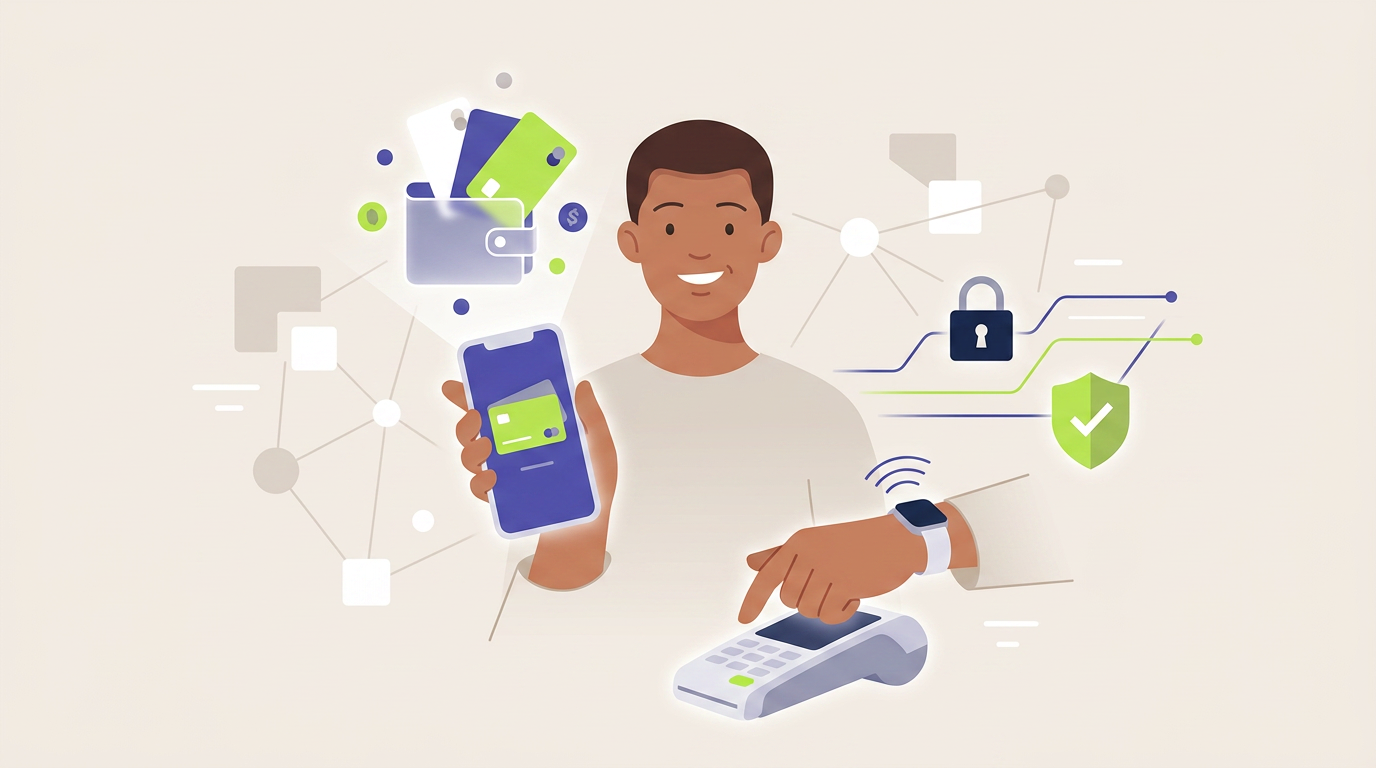
A digital wallet is an application or online service that stores payment credentials, account access, or a prepaid balance and allows users to complete digital transactions. Depending on the wallet, it may support online checkout, contactless payments, money transfers, tickets, loyalty cards, and other digital credentials.
A digital wallet does not always hold money directly. Many wallets act as a secure interface between the user and an existing bank account, payment card, or payment service.
This distinction is important because the wallet visible on a phone is only one part of the transaction. Banks, card networks, merchants, payment processors, and security systems may all operate behind the same payment.
What Is a Digital Wallet?
A digital wallet is software that helps a user store and use digital payment information. It can replace the need to enter card or account details manually every time a payment is made.
Depending on the provider, a digital wallet may contain:
- payment card credentials;
- access to a bank account;
- a prepaid monetary balance;
- transaction history;
- loyalty cards and coupons;
- tickets and boarding passes;
- identity or access credentials;
- authentication information.
The exact digital wallet meaning depends on how the product is designed. A mobile wallet may allow a user to tap a contactless terminal. A web-based wallet may provide faster online checkout. An electronic wallet may maintain a separate balance that must be funded before use.
The terms digital wallet, mobile wallet, e-wallet, and payment app are therefore related, but they are not always interchangeable.
How Does a Digital Wallet Work?
A digital wallet connects the user, funding source, merchant, and payment infrastructure. The exact process varies, but a typical card-funded payment follows several basic stages.
1. The User Adds a Payment Method
The user links a debit card, credit card, bank account, or prepaid balance to the digital wallet app.
The wallet provider may ask the issuing bank or payment service to verify that the user is authorized to add the account. Verification may involve a one-time code, confirmation inside a banking application, identity checks, or customer support review.
2. The Wallet Creates or Stores a Payment Credential
A secure wallet does not necessarily reuse the original card number for every transaction.
Many card-based wallets use tokenization. This process replaces sensitive card information with a substitute payment token. The token may be limited to a particular wallet, device, merchant, or transaction environment.
As a result, the merchant may receive the token rather than the original card number.
3. The User Authorizes the Payment
Before sending a payment instruction, the wallet may require:
- a device passcode;
- a wallet PIN;
- a fingerprint;
- facial recognition;
- a password;
- a one-time verification code;
- confirmation inside a banking app.
Authentication confirms that the person using the wallet has access to the required account or device. However, it does not guarantee that the payment decision itself is safe.
4. The Wallet Sends the Payment Instruction
The wallet sends the necessary credential or payment instruction through the appropriate payment channel.
The transaction may travel through:
- a card network;
- a bank transfer system;
- an instant-payment network;
- the wallet provider’s internal ledger;
- a merchant payment gateway;
- another payment processor.
5. The Transaction Is Authorized and Settled
The relevant financial institution checks the account status, available funds, payment rules, and transaction risk.
The merchant may receive confirmation within seconds, although final settlement between the financial institutions can occur later.
Does a Digital Wallet Actually Store Money?
Sometimes it does, but often it does not.
This is one of the most common misunderstandings about digital wallets. Some wallets store only payment credentials, while others maintain a separate balance belonging to the user.
| Wallet structure | What the wallet stores | Where the money normally remains |
|---|---|---|
| Card-based wallet | Card credential or payment token | Card account at the issuing bank |
| Bank-linked wallet | Permission to access a bank account | User’s bank account |
| Stored-value wallet | Separate prepaid balance | Account managed by the wallet provider or financial partner |
| P2P payment wallet | Wallet balance, linked account, or both | Wallet account, bank account, or payment card |
A card-based mobile wallet usually does not remove money from the card account when the card is added. The wallet simply provides another way to use that card.
A stored-value electronic wallet works differently. The user may first transfer money into the wallet and then spend from the available wallet balance.
Understanding this structure matters because fees, withdrawal rules, refunds, account protection, and recovery procedures may differ.
Main Types of Digital Wallets
Mobile Wallet
A mobile wallet is a digital wallet designed primarily for a smartphone, smartwatch, or another portable device.
Mobile wallets may support contactless payments, online purchases, in-app transactions, tickets, and account management.
The answer to “what is a mobile wallet?” therefore depends on the device rather than the underlying payment system. The wallet may still process a card payment, bank transfer, or stored-value transaction.
Web Wallet
A web wallet is accessed through a browser or online account.
It may store payment credentials, delivery information, and transaction history so that users do not need to enter the same details repeatedly.
Web wallets are commonly used for e-commerce, subscription services, and marketplace purchases.
Stored-Value Wallet
A stored-value wallet maintains a monetary balance controlled through the wallet account.
The user may add money through a bank transfer, payment card, cash agent, salary payment, or another supported funding method.
Stored-value wallets can be useful for small payments, transfers between users, or transactions within a particular platform ecosystem.
Bank Wallet
A bank wallet is provided by a bank or closely integrated with a bank account.
It may support merchant payments, transfers, bill payments, QR codes, digital cards, transaction alerts, and account management.
The wallet and bank account may appear to be one product, although several payment systems can still operate behind the interface.
Closed Wallet
A closed wallet can normally be used only within one company or platform.
Examples include a marketplace credit balance, store account, transport wallet, or service-specific payment balance.
Funds in a closed wallet may not be transferable to a bank account or usable with other merchants.
Digital Wallet vs Mobile Wallet vs Payment App
| Term | Main meaning | Must be used on a phone? | Can hold a balance? |
|---|---|---|---|
| Digital wallet | Broad category for storing and using digital payment credentials | No | Sometimes |
| Mobile wallet | Digital wallet designed for mobile devices | Usually | Sometimes |
| E-wallet | Electronic wallet, often associated with a stored balance | No | Frequently |
| Payment app | Application used to initiate or manage payments | Usually | Sometimes |
| Banking app | Application used to access a bank account | Usually | Money normally remains in the bank account |
A payment app can include wallet features without functioning as a complete digital wallet. Similarly, a banking app can initiate payments even when the user has not added a card to a separate mobile wallet.
The most reliable way to classify a service is to examine what it stores, which funding sources it uses, and which transactions it can initiate.
What Can a Digital Wallet Be Used For?
Contactless Payments
A mobile wallet can communicate with a compatible payment terminal using near-field communication, commonly known as NFC.
The user normally unlocks the device, selects a card when necessary, and places the device close to the terminal. The wallet then transmits the required payment credential.
The merchant may receive a payment token instead of the user’s original card number.
Online and In-App Checkout
A digital wallet can make online checkout faster by providing stored payment credentials and delivery information.
This reduces the need to type card details into every merchant website or mobile application.
A wallet may also reduce the number of merchants that receive the user’s original payment information directly.
Person-to-Person Payments
Some wallets allow users to send money directly to friends, relatives, sellers, or service providers.
The transfer may use a stored balance, payment card, or linked bank account. Our separate guide explains how a P2P transfer works, including settlement, fees, reversals, and fraud risks.
QR Code Payments
The user or merchant displays a QR code containing payment information. The other party scans the code, checks the recipient and amount, and confirms the payment.
QR payments can operate through bank accounts, instant-payment systems, stored-value wallets, or card-funded applications.
Tickets, Loyalty Cards, and Access Credentials
A digital wallet may also store:
- travel tickets;
- event passes;
- membership cards;
- loyalty points;
- discount coupons;
- hotel keys;
- building access credentials.
These functions do not always involve a financial transaction, but they turn the wallet into a broader tool for digital access and account management.
Digital Wallet Examples by Function
Digital wallet examples are easier to understand when grouped by function rather than by individual brands.
| Wallet function | Example use |
|---|---|
| Card wallet | Adding a bank card and tapping a phone at a payment terminal |
| Online checkout wallet | Paying on a website through a stored account |
| Stored-value wallet | Adding funds and spending from the wallet balance |
| Bank wallet | Paying merchants directly from a banking application |
| P2P wallet | Sending money to another user |
| Transport wallet | Paying fares or storing travel tickets |
| Platform wallet | Receiving refunds or credits inside an online marketplace |
One digital wallet app may perform several of these functions at the same time.
How Secure Are Digital Wallets?
A well-designed digital wallet can reduce certain forms of payment exposure, but no wallet eliminates financial risk.
Security depends on the device, wallet provider, funding source, payment system, merchant, and behaviour of the account holder.
Payment Tokenization
Tokenization replaces valuable payment information with a substitute credential.
A stolen token may be less useful than a stolen card number when it is restricted to one device, wallet, merchant, or transaction type.
Tokenization does not prevent every form of fraud, but it can reduce the exposure of original card details.
Device Authentication
A wallet may require a passcode, fingerprint, facial recognition, or another authentication method before allowing a payment.
Device authentication can make a lost or stolen phone harder to use. A strong screen lock also helps protect messages, email accounts, and banking applications that could otherwise be used to reset wallet credentials.
Encryption and Protected Storage
Payment credentials may be encrypted or stored in protected hardware and software environments.
The exact implementation differs between devices and wallet providers. Users should not judge the security of an application only by its design or popularity.
Fraud Monitoring
Wallet providers, banks, and payment processors may evaluate:
- transaction amount;
- device identity;
- location;
- merchant category;
- purchase patterns;
- login behaviour;
- recent account changes;
- signs of automated abuse.
A suspicious payment may require additional verification or may be declined.
For a broader explanation of account protection, transaction monitoring, and fraud prevention, read our guide to digital payment security.
The Biggest Risk May Be a Payment the User Approves
Many people assume that the main digital wallet risk is a criminal secretly intercepting a contactless payment.
In practice, a more serious problem can occur when a criminal persuades the legitimate account holder to approve the transaction.
The wallet may successfully authenticate the correct person while that person is responding to:
- a fake emergency;
- a fraudulent investment offer;
- an impersonated bank employee;
- a fake marketplace seller;
- a false refund request;
- a phishing message;
- a manipulated QR code.
Authentication confirms who approved a transaction. It does not confirm that the transaction was honest.
This distinction explains why biometric authentication and one-time codes cannot prevent every scam. Technical security controls can work correctly while the user is being manipulated.
Common Digital Wallet Risks
Account Takeover
An attacker may obtain a password, verification code, email account, phone number, or access to the user’s device.
Account takeover can lead to unauthorized payments, changed contact details, newly added funding sources, or loss of access to the wallet.
Phishing
A fraudulent message or website may ask the user to enter wallet credentials or approve a login attempt.
Legitimate support representatives should not ask customers to disclose passwords, wallet PINs, or one-time authentication codes.
Fake Wallet Applications
A fraudulent application may imitate a legitimate digital wallet and collect payment details, passwords, or identity information.
Users should install financial applications only from trusted stores and carefully verify the publisher.
Lost or Stolen Devices
A stolen phone can expose more than the wallet itself.
Email, text messages, saved passwords, authentication applications, and banking services may provide several ways to reset or access financial accounts.
Privacy and Data Collection
A wallet may process transaction history, location, device information, merchant data, and behavioural signals.
Some information is necessary for security and payment processing. Other data may be used for analytics, marketing, product development, or risk scoring.
Refund and Dispute Confusion
Refund rights depend on the payment type and funding source.
A card-funded wallet payment, bank transfer, stored-balance transaction, and voluntary P2P payment may follow different dispute procedures.
The wallet interface can look the same even when the legal and operational protections are different.
Digital Wallet Security Tips
- Use a strong device passcode. A longer passcode provides better protection than a simple four-digit code.
- Enable biometric authentication. Fingerprint or facial recognition can add a convenient security layer.
- Turn on transaction notifications. Immediate alerts help users notice unauthorized activity quickly.
- Protect the connected email account. An attacker who controls the user’s email may be able to reset the wallet password.
- Never share verification codes. Legitimate support staff should not ask for a one-time authentication code.
- Verify the recipient before sending money. Check the name, account, phone number, username, and transaction amount.
- Do not trust payment screenshots. A screenshot is not proof that money has arrived.
- Keep the device and application updated. Updates may correct security vulnerabilities and compatibility problems.
- Remove unused cards and old devices. Forgotten credentials increase the number of possible access points.
- Learn the recovery procedure in advance. Know how to lock the wallet, remove a device, contact the provider, and report suspicious activity.
Advantages and Disadvantages of Digital Wallets
| Advantages | Disadvantages |
|---|---|
| Faster online and in-person checkout | Acceptance varies between merchants and countries |
| Reduced need to carry physical cards | Depends on access to a device, battery, or network |
| Tokenization can reduce card-data exposure | Scammers can still persuade users to approve payments |
| Centralized transaction history | Wallet providers may collect significant user data |
| Convenient P2P and QR payments | Refund and dispute rules may be confusing |
| Support for tickets and loyalty cards | Account recovery can be difficult after device loss |
| Multiple funding sources in one interface | Fees and currency conversion costs may be unclear |
The best wallet is not automatically the product with the largest number of features.
A useful wallet should make payment rules, fees, recipient information, security controls, and recovery procedures easy to understand.
How to Choose a Digital Wallet
Check Merchant Acceptance
A wallet has limited value when it is not accepted by the merchants, websites, or people the user regularly pays.
Check both physical and online acceptance before relying on one wallet as the main payment method.
Review the Supported Funding Sources
Determine whether the wallet supports:
- debit cards;
- credit cards;
- bank accounts;
- cash top-ups;
- prepaid balances;
- instant payments.
The funding source can affect transaction speed, fees, dispute rights, and the account from which money is taken.
Understand the Fees
Possible costs include:
- wallet top-up fees;
- withdrawal fees;
- money transfer fees;
- merchant charges;
- inactivity fees;
- foreign-exchange markups;
- instant-transfer charges.
A wallet marketed as free may still create costs through currency conversion or particular funding methods.
Examine the Recovery Options
A reliable recovery process should explain what happens when:
- the phone is lost;
- the user changes phone numbers;
- the account is locked;
- biometric authentication fails;
- the wallet provider closes;
- the user cannot access the registered email account.
Review Privacy Controls
Check what information the wallet collects and whether unnecessary tracking, location access, or marketing permissions can be disabled.
Compare Fraud and Dispute Procedures
Before using a wallet for large transactions, determine how the provider handles:
- unauthorized payments;
- authorized scams;
- duplicate charges;
- failed transfers;
- merchant disputes;
- refunds;
- account freezes.
Practical Note: The Funding Source Still Matters
Two payments made through the same wallet can have different protections when one uses a payment card and the other uses a stored balance or bank transfer.
Users should therefore examine both the wallet rules and the rules of the underlying funding source.
Will Digital Wallets Replace Cash and Cards?
Digital wallets are more likely to change how existing payment methods are accessed than to replace every underlying payment instrument.
A person may appear to pay with a wallet while the transaction is still processed as a card payment, bank transfer, or stored-value transaction.
The digital wallet functions as an interface between the user and the payment infrastructure operating behind it.
Cash, physical cards, bank accounts, and digital wallets are therefore likely to coexist. Their relative importance will depend on merchant acceptance, access to devices, consumer protection, privacy, security, and the reliability of payment networks.
Frequently Asked Questions
What is a digital wallet in simple terms?
A digital wallet is an application or online service that stores payment credentials or a monetary balance and helps users pay merchants, transfer money, or access digital tickets and other credentials.
Is a digital wallet the same as a bank account?
No. A digital wallet may connect to a bank account, but the wallet and bank account are normally separate products. Some wallets also maintain their own prepaid balance.
Is a mobile wallet the same as a digital wallet?
A mobile wallet is a type of digital wallet designed for smartphones, smartwatches, or other portable devices. Digital wallets can also operate through websites and desktop services.
Are digital wallets safe?
Digital wallets can be secure when they use tokenization, strong authentication, encryption, fraud monitoring, and protected devices. Users can still lose money through phishing, account takeover, fake applications, or payments voluntarily sent to scammers.
Can a digital wallet work without a bank account?
Some stored-value wallets can work without a traditional bank account. They may be funded through cash agents, payment cards, employers, transfers, or other wallet users.
What happens if a phone containing a digital wallet is lost?
The user should remotely lock or erase the device, remove it from the wallet account, contact the wallet provider or bank, review recent transactions, and change exposed passwords.
Does a digital wallet expose the card number to the merchant?
Not always. Many card-based wallets use a payment token instead of transmitting the original card number. The exact process depends on the wallet, device, card network, and transaction type.
Can a digital wallet charge fees?
Yes. Possible charges include top-up fees, transfer fees, withdrawal fees, foreign-exchange markups, and fees for using particular funding sources.
Summary
A digital wallet is a software layer that stores and uses payment credentials, account access, prepaid balances, or other digital information.
Digital wallets can support contactless payments, online checkout, P2P transfers, QR payments, tickets, loyalty programs, and access credentials.
The most important points are:
- a digital wallet does not always hold money directly;
- a mobile wallet may still use cards or bank transfers underneath;
- tokenization can reduce exposure of original card details;
- authentication cannot prevent a user from approving a scam;
- fees and protections depend on the funding source;
- device security and account recovery are essential;
- digital wallets are likely to coexist with cash, cards, and bank accounts.