
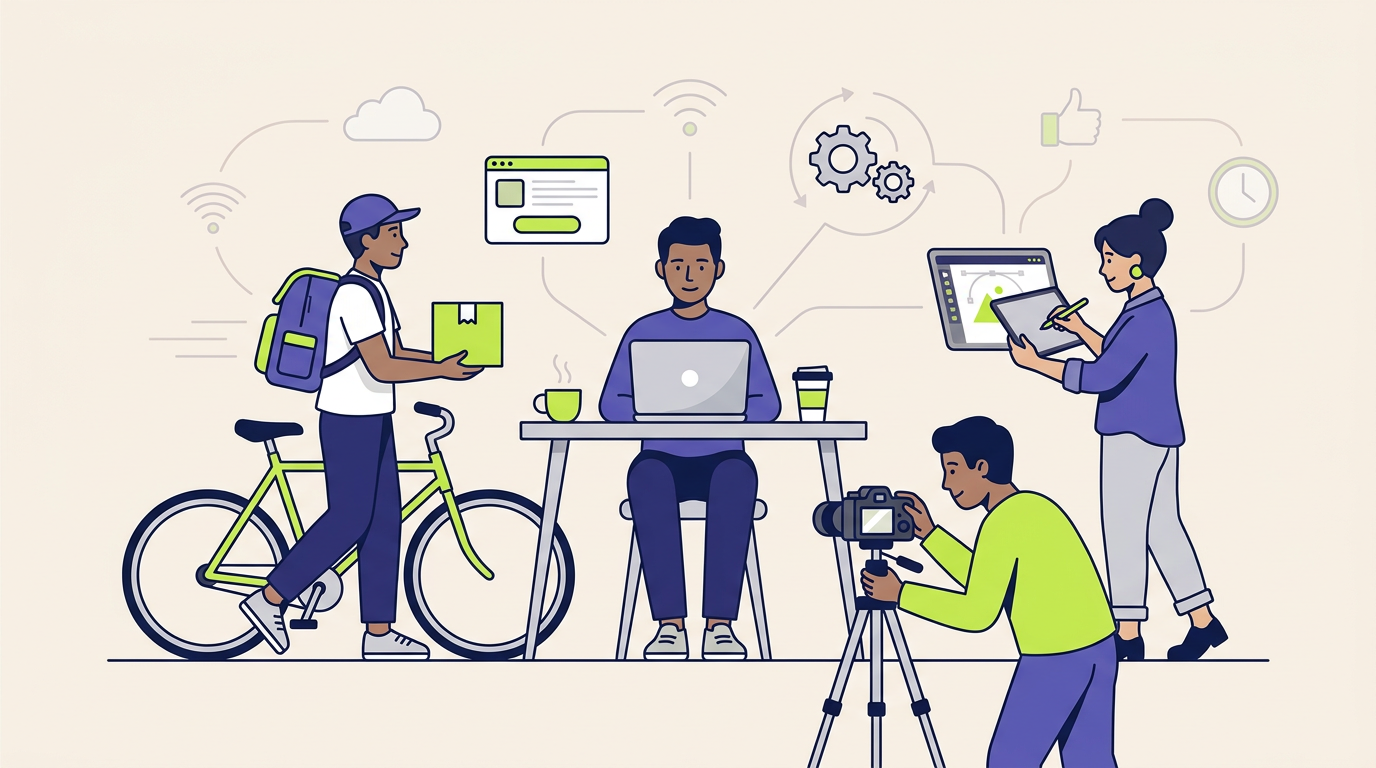
The gig economy is a labor market in which people earn money by completing temporary assignments, individual projects, or on-demand services instead of working only through permanent jobs. Digital platforms often connect customers with workers, organize payments, rank participants, and distribute opportunities, although gig work can also be arranged directly without an application.
This model includes activities such as delivery, transportation, freelance design, programming, tutoring, domestic services, data annotation, consulting, and short-term professional projects.
However, the term is often used too broadly. Not every freelancer uses a platform, not every temporary employee is a gig worker, and not every person who earns money through an application depends on that activity as a main source of income.
What Is the Gig Economy?
The gig economy is the part of the labor market where paid work is divided into separate tasks, assignments, shifts, projects, or service requests.
Instead of receiving an open-ended job with a fixed schedule and continuing salary, a worker is normally paid for completing a defined unit of work.
That unit may be:
- one delivery;
- one passenger journey;
- one graphic-design project;
- one home repair;
- one tutoring session;
- one data-labeling task;
- one consulting assignment;
- one temporary shift;
- one written article;
- one completed customer request.
The work can be organized directly between a client and an independent provider. Increasingly, however, software platforms coordinate the transaction by matching participants, displaying offers, processing payments, collecting reviews, and setting rules.
This connection to digital intermediation places gig work within the wider platform economy. Our guide to the peer-to-peer platform model explains how technology can connect individual participants without requiring the platform to provide the underlying service itself.
What Does Gig Economy Mean in Practice?
In practical terms, the model changes the unit around which work is organized.
A traditional job is usually organized around an ongoing employment relationship. Gig work is organized around a result, task, booking, or limited period.
| Traditional employment unit | Gig-work unit |
|---|---|
| Ongoing position | Individual assignment or project |
| Regular working schedule | Available tasks, bookings, or selected hours |
| Salary or hourly payroll | Payment per task, delivery, project, or session |
| Employer manages the workflow | Worker, client, platform, or algorithm organizes the workflow |
| Relationship continues after one task | Relationship may end when the task is complete |
| Benefits may be attached to the job | Worker may need to arrange benefits and protection independently |
The difference is not always clear. A person can complete temporary projects for the same client over several years, while someone described as an independent provider may work under strict platform control.
Therefore, the label used in an application or contract does not always describe the real economic relationship.
How Does the Gig Economy Work?
A typical transaction involves a customer, a worker, and sometimes a digital platform.
1. A Customer Creates Demand
An individual or business needs a service. The customer may request transportation, delivery, design, programming, cleaning, translation, consulting, or another form of work.
2. Workers Receive or Find the Opportunity
The assignment may be offered through:
- a mobile application;
- an online marketplace;
- a freelance website;
- a staffing platform;
- a professional network;
- a direct referral;
- a personal business website;
- a local advertising service.
Some systems allow workers to browse projects and submit proposals. Others automatically offer jobs based on location, availability, rating, price, experience, or previous activity.
3. The Terms Are Established
The price may be:
- set by the worker;
- proposed by the customer;
- negotiated by both parties;
- calculated by the platform;
- determined through bidding;
- adjusted according to demand.
Other important terms include the deadline, location, expected result, cancellation policy, platform fee, payment schedule, and dispute process.
4. The Worker Completes the Assignment
The task may be performed online or at a physical location.
Online work includes writing, software development, design, data processing, customer support, translation, and professional consulting.
Location-based work includes transportation, delivery, household services, care work, construction, repair, and event staffing.
5. Payment Is Processed
The customer may pay the worker directly. On a platform, the intermediary commonly receives the customer’s payment, deducts applicable fees, and transfers the remaining amount to the provider.
6. Performance Is Recorded
Many systems collect ratings, reviews, acceptance rates, cancellation records, response times, completion data, and customer complaints.
These records can influence whether a worker receives future opportunities.
The Role of Digital Platforms
A digital labor platform does more than publish an advertisement. It can actively organize the transaction.
Platform functions may include:
- matching customers with workers;
- setting or recommending prices;
- assigning tasks;
- processing payments;
- verifying identities;
- collecting customer reviews;
- monitoring location or activity;
- resolving disputes;
- ranking workers;
- suspending accounts.
This makes many labor platforms similar to online marketplaces, but the item being exchanged is work or a service rather than only a physical product.
The platform can reduce the time required for a customer and worker to find each other. At the same time, it may gain considerable influence over prices, visibility, communication, and access to future assignments.
How Gig Economy Platforms Make Money
Most platforms earn revenue by charging for access to the transaction or related services.
| Revenue method | How it works | Who normally pays |
|---|---|---|
| Transaction commission | The platform keeps a percentage of each completed payment | Worker, customer, or both |
| Fixed service fee | A set amount is added to each booking or assignment | Usually the customer |
| Worker fee | A portion is deducted before earnings are transferred | Worker |
| Subscription | Participants pay for continued or premium access | Worker, customer, or business |
| Lead fee | A provider pays to contact or quote a potential customer | Worker or service business |
| Promoted placement | Providers pay for additional visibility | Worker or business |
| Payment-processing fee | A separate charge covers payment collection and transfer | Worker or customer |
| Business services | The platform sells staffing, analytics, verification, or management tools | Business customer |
A single platform may combine several methods. It can charge the customer a service fee, deduct a commission from the worker, and sell optional visibility tools.
Our analysis of how marketplace platforms charge fees explains why headline commissions rarely show the full cost of participating in a platform.
Common Gig Economy Examples
Transportation
Drivers accept individual passenger journeys through an application. The platform commonly handles matching, pricing, route information, payment, and reviews.
Food and Parcel Delivery
Couriers complete individual delivery requests. Earnings can depend on distance, demand, waiting time, incentives, customer tips, and operating expenses.
Freelance Professional Services
Designers, programmers, writers, marketers, accountants, and consultants complete projects for businesses or individuals.
The engagement may involve a fixed price, hourly billing, milestones, or a continuing series of separate assignments.
Household and Local Services
Customers book cleaning, furniture assembly, maintenance, moving assistance, gardening, repair, care, or other services.
Teaching and Tutoring
Instructors provide individual lessons, language practice, examination preparation, music instruction, or professional coaching.
Microtask Work
Large projects are divided into small tasks such as image classification, transcription, content review, data verification, or search-result evaluation.
Creative and Media Work
Photographers, video editors, performers, voice artists, musicians, and other creators may be hired for individual events or projects.
Temporary Shift Platforms
Businesses use applications to fill short-term shifts in hospitality, retail, logistics, events, administration, healthcare, or warehousing.
What Does Not Automatically Count as Gig Work?
The boundaries are important because several labor arrangements can appear similar.
| Arrangement | Why it is not automatically gig work |
|---|---|
| Permanent remote employment | The employee may work online but still has an ongoing job |
| Temporary employment contract | The worker may be hired as an employee for a defined period |
| Small business ownership | The owner may operate an independent business rather than accept separate gigs |
| Product selling | Selling goods through a marketplace does not necessarily involve paid labor services |
| Traditional self-employment | A professional may maintain long-term clients without using task-based arrangements |
| Casual unpaid activity | Personal assistance or volunteering is not paid gig work |
| Using communication software | A video or messaging application may facilitate communication without organizing the work |
A useful test is to ask whether the income is connected to a specific task, project, shift, or service request and whether the relationship is expected to continue independently of that assignment.
Gig Economy vs Platform Economy
The platform economy is broader than the labor market.
It includes digital systems that connect different groups for:
- buying and selling goods;
- booking accommodation;
- obtaining financing;
- sending payments;
- sharing content;
- providing professional services;
- finding short-term work.
The gig economy specifically concerns paid labor organized around assignments or limited engagements.
A delivery application can be part of both categories because it is a platform and it coordinates paid work. A product marketplace may belong to the platform economy without forming part of the labor market.
Gig Economy vs Freelancing
Freelancing and gig work overlap, but they are not identical.
| Factor | Gig work | Freelancing |
|---|---|---|
| Typical unit | Task, booking, shift, or short project | Project or professional service |
| Platform involvement | Common but not required | Optional |
| Pricing control | May be controlled or influenced by a platform | Often negotiated by the freelancer |
| Customer relationship | Can be brief and anonymous | May develop into a continuing client relationship |
| Skill range | Includes local, manual, creative, and professional tasks | Often associated with professional or creative services |
| Business identity | Worker may operate mainly through a platform profile | Freelancer may build an independent brand and client base |
A freelance developer completing a three-month software project participates in flexible independent work. A courier accepting individual deliveries participates in task-based platform work. Both can be described as gig workers, but their pricing power, costs, risks, and client relationships are very different.
Gig Work vs Traditional Employment
| Criterion | Gig arrangement | Traditional employment |
|---|---|---|
| Continuity | Assignments may end individually | Employment continues until resignation or termination |
| Schedule | Potentially flexible or demand-based | Usually set or agreed with the employer |
| Income | Can vary with completed work and demand | Usually more predictable |
| Equipment | Often supplied by the worker | Often supplied by the employer |
| Expenses | Frequently paid by the worker | Business expenses are commonly paid by the employer |
| Benefits | May need to be arranged independently | May be attached to employment |
| Management | Worker, client, platform, or algorithm | Employer and management structure |
| Opportunity access | Depends on demand, ranking, bids, or platform access | Work is assigned within the ongoing job |
Actual legal classification depends on the applicable jurisdiction and the real degree of control, independence, and economic dependence. A contractual label alone does not resolve that question.
Advantages of the Gig Economy
Flexible Entry
Some forms of work allow people to begin earning without a lengthy recruitment process.
This can help people who need temporary income, are changing careers, have irregular availability, or face barriers to conventional employment.
Control Over Working Time
Workers may be able to choose when to accept assignments.
The value of this flexibility depends on whether attractive work is actually available during the preferred hours.
Multiple Sources of Income
A person can combine several clients, platforms, services, or occupations instead of relying on one employer.
Diversification can reduce dependence on a single customer, although managing several sources also creates additional administrative work.
Access to a Larger Market
Online platforms can connect a worker with customers outside the local area. A professional service provider may compete for projects across regions or countries.
Opportunity to Test a Business Idea
Short projects can help a person test demand, pricing, skills, and customer preferences before building a larger independent business.
Rapid Staffing for Businesses
Companies can obtain specialized expertise or additional capacity without creating a permanent position for every temporary requirement.
Customer Convenience
Customers can compare availability, prices, profiles, reviews, and service categories in one interface.
Disadvantages and Risks
Unpredictable Income
Demand can change by day, season, location, platform policy, customer budget, and broader economic conditions.
A high-earning week does not guarantee that similar opportunities will remain available.
Unpaid Working Time
Payment commonly covers the completed task rather than every minute required to obtain and prepare for it.
Unpaid activities may include:
- searching for projects;
- submitting proposals;
- waiting for a booking;
- travelling to a starting location;
- communicating with customers;
- correcting rejected work;
- managing disputes;
- maintaining a profile;
- tracking expenses and taxes.
ILO research found that online web-based platform workers spent about 23 hours per week on platform activity, with roughly eight hours devoted to unpaid work.
Worker-Funded Expenses
Gross revenue is not the same as usable earnings.
A worker may need to pay for:
- fuel and transportation;
- vehicle maintenance;
- equipment;
- software;
- internet and telephone service;
- insurance;
- workspace;
- professional training;
- platform charges;
- payment-processing costs.
Limited Access to Benefits
Depending on the arrangement and country, workers may need to arrange retirement savings, insurance, paid leave, training, and income protection independently.
Dependence on Ratings
A small number of negative reviews can reduce access to work, especially when the platform provides limited explanation or appeal options.
Account Suspension Risk
When one application supplies most of a worker’s income, account restriction can function like an immediate loss of work.
Price Competition
Large pools of providers may pressure workers to lower prices, particularly when customers can compare many offers quickly.
Weak Customer Relationships
Some platforms limit direct communication or prevent workers from moving customers outside the system. This makes it harder to build an independent client base.
The Hidden Cost of a Gig
A task should not be evaluated only by its advertised payment.
A more useful calculation is:
Net gig earnings = customer payment − platform fees − operating expenses − unpaid-time cost − applicable taxes and contributions.
Consider a service advertised at $60.
The worker may spend:
- 30 minutes finding and confirming the assignment;
- one hour travelling and waiting;
- two hours completing the work;
- 30 minutes communicating and closing the task.
The assignment represents four hours of total time rather than only two hours of visible work.
After fees, transport, equipment, and other expenses, the worker’s effective hourly earnings may be substantially lower than the headline price suggests.
Practical Insight: Measure the Entire Work Cycle
The correct unit for evaluating gig income is not the paid task. It is the complete cycle required to obtain, perform, and close that task.
A worker should track:
- paid time;
- unpaid time;
- platform deductions;
- direct expenses;
- cancelled assignments;
- payment delays;
- rework and disputes.
This produces a more realistic comparison with employment, freelancing, or another platform.
How Algorithms Can Manage Work
Many platforms use computer-programmed procedures to organize labor.
Algorithmic management may influence:
- which worker sees an assignment;
- the order in which providers appear;
- suggested or fixed prices;
- performance scores;
- incentives;
- work schedules;
- customer matching;
- account warnings;
- suspension decisions.
This can reduce search time and coordinate large numbers of transactions efficiently.
However, it can also make important decisions difficult to understand. A worker may know that the number of assignments has declined without knowing which rating, cancellation, response time, location, or automated rule caused the change.
Expert Insight: Flexibility and Control Can Exist Together
The ability to log in or out does not necessarily mean that a worker controls every important part of the work.
A platform can provide schedule flexibility while still influencing prices, visibility, task allocation, customer communication, and access to future income.
Therefore, platform independence should be assessed across several dimensions rather than by asking only whether the worker chooses when to open the application.
Why Gig Economy Statistics Often Disagree
There is no single universally applied measurement for the entire sector.
Studies may count:
- everyone who completed one task during the year;
- people who worked during the previous week;
- workers using digital labor platforms;
- all independent contractors;
- people receiving any platform income;
- only workers whose main income comes from gigs;
- location-based workers;
- online freelancers;
- temporary and on-call workers.
These groups are not interchangeable.
For example, the U.S. Bureau of Labor Statistics identified 11.9 million independent contractors in their sole or main job in July 2023, representing 7.4 percent of employment. That number should not be presented as the size of platform work because independent contractors also include professionals, tradespeople, business operators, and other workers who may never use a labor application.
The OECD, ILO, and European Union measurement handbook also notes that small differences in survey wording can have a large effect on estimates.
How to Read a Gig Economy Statistic
Before accepting a number, check:
- Who is included? Platform workers, freelancers, contractors, temporary workers, or all self-employed people?
- What is the reference period? Previous week, month, or year?
- Is secondary income counted? Many people use gigs alongside another job.
- Is the work platform-mediated? Direct freelance activity may be included or excluded.
- Is the estimate based on workers, accounts, or transactions? One person can use several platforms.
- Does it cover online and location-based work? Some surveys measure only one type.
Is the Gig Economy Good for Workers?
It can be useful when the worker gains genuine flexibility, understands the costs, controls pricing, maintains several sources of demand, and can leave the arrangement without losing financial stability.
It becomes more risky when:
- one platform supplies nearly all income;
- prices are set without cost transparency;
- large amounts of work are unpaid;
- account suspension cannot be challenged;
- the worker carries substantial operating expenses;
- demand is unpredictable;
- the arrangement replaces stable employment without comparable protection.
The same platform can function as convenient supplementary income for one person and precarious full-time work for another.
Is the Model Good for Businesses?
Task-based labor can help a business handle temporary demand, obtain specialized expertise, expand into a new market, or complete a defined project.
However, businesses should not assume that every activity is suitable for fragmented external work.
Potential problems include:
- loss of institutional knowledge;
- inconsistent service quality;
- data-security exposure;
- unclear responsibility;
- worker-classification disputes;
- dependence on a third-party platform;
- difficulty maintaining company culture;
- repeated onboarding costs.
Core activities requiring close supervision, confidential information, long-term development, or continuous teamwork may be better suited to stable internal roles.
How to Evaluate a Gig Opportunity
| Question | Why it matters |
|---|---|
| Who sets the price? | Determines the worker’s ability to respond to costs and complexity |
| How much time is unpaid? | Changes the effective hourly earnings |
| Which fees are deducted? | Reduces the amount received from the customer price |
| Who pays operating expenses? | Shows whether the advertised amount is gross or close to net income |
| How reliable is demand? | Determines income predictability |
| Can customers cancel without payment? | Creates a risk of wasted time and expenses |
| How are disputes decided? | Affects payment and account security |
| Can a suspension be appealed? | Matters when platform access is economically important |
| Can the worker build direct clients? | Reduces long-term platform dependence |
| When is payment released? | Affects cash flow |
When Gig Work May Be a Good Fit
The arrangement may be useful for someone who:
- needs supplementary income;
- values control over available hours;
- wants to test a service or skill;
- has several sources of customers;
- can accurately track costs;
- maintains an emergency reserve;
- does not depend on one platform;
- has skills that support pricing power.
When It May Be a Poor Fit
Greater caution is needed when someone:
- requires predictable monthly income;
- cannot absorb delayed or cancelled payments;
- must purchase expensive equipment;
- depends on employer-provided benefits;
- cannot manage taxes and records independently;
- has no alternative after an account suspension;
- cannot choose prices or reject unprofitable tasks;
- must work long hours to cover unpaid time and expenses.
The Future of the Gig Economy
Task-based work is likely to remain part of the labor market because platforms can reduce the cost of matching customers with workers.
Future development will depend on several competing forces:
- demand for flexible services;
- worker expectations for income stability;
- regulation of employment classification;
- transparency of automated decisions;
- access to benefits and insurance;
- portable reputation and credentials;
- competition between platforms;
- automation of routine tasks;
- growth of specialized professional platforms.
The sector may not move toward one universal model. Local delivery, professional freelancing, temporary staffing, care work, and online microtasks have different economics and require different protections.
Expert Insight: The Main Question Is Who Controls the Infrastructure
The long-term balance of power depends on who controls access to customers, payment data, ratings, prices, and reputation.
A worker with transferable skills, direct customer relationships, several platforms, and portable reviews has more bargaining power than a worker whose entire economic history remains locked inside one application.
For that reason, the future of task-based work is not only about flexibility. It is also about control over the infrastructure required to earn.
Frequently Asked Questions
What is the gig economy in simple terms?
The gig economy is a labor market where people earn money from individual tasks, projects, bookings, or temporary assignments rather than relying only on permanent employment.
How does the gig economy work?
A customer requests a service, a worker accepts or proposes terms, the task is completed, and payment is made. A digital platform may manage matching, pricing, communication, reviews, and payment.
What are common gig economy examples?
Examples include transportation, food delivery, freelance design, programming, writing, tutoring, home services, consulting, temporary shifts, and online microtasks.
Is every freelancer a gig worker?
No. Freelancing overlaps with gig work, but some freelancers maintain long-term client relationships and operate independent businesses rather than accepting separate platform-organized tasks.
Is every gig worker self-employed?
No. Classification depends on the arrangement and applicable law. Some short-term or platform-based workers may be employees, temporary employees, contractors, or workers in another legal category.
What are the main benefits of the gig economy?
Potential benefits include flexible scheduling, easier market access, multiple income sources, rapid entry into some activities, and the ability to test a service or business idea.
What are the main disadvantages?
Main disadvantages include unpredictable income, unpaid working time, worker-funded expenses, limited benefits, rating dependence, platform fees, and the risk of account suspension.
Are gig economy earnings higher than regular wages?
Not necessarily. Advertised task payments must be reduced by platform fees, expenses, unpaid time, cancellations, taxes, and other costs before making a valid comparison.
What is a gig economy platform?
A gig economy platform is a digital service that connects customers with workers and may organize assignments, pricing, payments, ratings, communication, and access to future work.
What is algorithmic management?
Algorithmic management uses computer-programmed procedures to assign work, rank workers, monitor performance, calculate incentives, or make other decisions affecting access to assignments.
Why do estimates of gig workers vary?
Estimates vary because studies use different definitions, reference periods, survey questions, income thresholds, and rules for including secondary work, freelancers, contractors, and platform users.
Is gig work suitable as a main income source?
It may be suitable when demand is reliable, costs are controlled, income sources are diversified, and the worker has financial protection against slow periods. Dependence on one platform increases risk.
Summary
The gig economy organizes paid work around individual assignments, projects, shifts, bookings, and service requests.
Digital platforms frequently support this model by matching workers with customers, processing payments, collecting ratings, and controlling access to opportunities.
The most important points are:
- gig work is defined by task-based or limited engagements rather than by one specific profession;
- online and location-based services can both be part of the model;
- not every freelancer, contractor, or temporary worker is a platform worker;
- platforms may earn through commissions, service fees, subscriptions, leads, and promoted placement;
- flexibility can coexist with strong platform control;
- headline payments should be reduced by fees, expenses, and unpaid time;
- ratings and automated systems can influence access to future work;
- statistics differ because researchers measure different groups and time periods;
- gig work is safer when income sources are diversified and the worker understands the full cost of each assignment;
- the central trade-off is flexibility versus predictability, protection, and control over the work process.